
Leading Schools Efficiently With AI Assistance
AI-assisted tools are not writing machines; they help structure work. They do not replace decisions, but can simplify routines and create room for educational leadership.
Norman Graf6 min read

In Germany, schools are subject to strict data protection regulations derived from the GDPR and each federal state's school laws, which means that any AI tool introduced by school leadership must be evaluated within that legal context.
Practical AI Time-Savers for School Leaders
When I speak with fellow school leaders about artificial intelligence, I often hear the same sentence:
“I see the potential, but I simply do not have time to explore it.”
That response is understandable. School leadership is fast-paced work marked by constant interruptions and enormous responsibility. That is exactly why, for me, the first question is not about innovation but about reducing workload—not as an end in itself, but as a condition for being able to shape a school at all. Public debate often connects AI with sweeping promises about the future. In my daily work as a vice principal, however, I see its value mainly in small tasks: simplifying routines, structuring thought processes, and creating room for educational leadership.
School leadership between aspiration and daily reality
School leadership constantly moves between strategic development and everyday operations. Parent communication, reports, concepts, minutes, and coordination all matter, but they are not always directly educational. Even so, they consume resources that are then missing elsewhere: in conversations with colleagues, school development, and reflection. For a long time, I believed that relief was primarily a matter of better organization. Today I know that it is also a matter of the tools we use and the mindset with which we approach them.
Digital assistants as tools for thinking and structure
For me, AI-assisted tools are not “writing machines,” but tools for structure. They do not replace decisions, but they can help organize thoughts, prepare drafts, and make alternatives visible. Through my work with fobizz, I have encountered and helped develop different assistant formats that begin precisely here—not by automating leadership, but by supporting it.
One principle has proven particularly valuable in my experience:
AI prepares; it does not decide. Responsibility ultimately remains with school leadership.
Parent communication: Clear, audience-aware, and efficient
Parent letters are a classic example from everyday work.
Whether the purpose is information, an invitation, or conflict communication, few texts are revised as often or weighed as carefully. They also consume a great deal of time. A guide for parent communication developed by school leadership from previous experience can serve as structured writing support. A few bullet points can become draft language that is clear, audience-aware, and factual. It is especially important that a leader's own voice does not disappear when using AI support. Revising AI-generated text should be part of every writing process, with human review built in as standard practice.
AI may know the provided context, but it does not understand every dimension of the particular situation or system. Fine-tuning tone, emphasis, and personal additions therefore remains a human task and, ultimately, the responsibility of school leadership.
In practice, that means I no longer begin with a blank document. I begin with a structured draft that I deliberately review, revise, and take responsibility for sending.
School Leadership Assistance for Ideas and Processes
Another use case is a purpose-built AI assistant for school leadership. It can support tasks that are less creative but cognitively demanding and often repetitive, such as:
- Structuring ideas for a concept
- Drafting reports from bullet points
- Preparing applications or school programs
For longer texts, AI can help organize ideas, plan a structure through an iterative process, and turn bullet points into draft sections. At its best, it is not used to generate content mechanically, but to divide complex subjects into meaningful sections and develop ideas through a kind of co-creation.
The following questions can help establish that structure:
- What purpose does the project serve?
- What is the central thread?
- Which aspects are still missing or need to be expanded?
- How could an idea be expressed more precisely?
The more clearly the intended outcome is defined, the more precisely an AI assistant can support the process. The real work with artificial intelligence is therefore not producing a particularly clever prompt, but planning the desired result. In my experience, this support can save time and often improve quality because it leaves more room for reflection on the content.
GDPR: Workload reduction requires clear boundaries
Data protection is a central issue in every conversation with school leaders, and rightly so. AI may be used only where applicable legal requirements are observed and sensitive data is protected.
In practice, this leads to a clear principle:
No personal data, no sensitive content, and a clear separation between draft and decision.
According to its provider documentation, fobizz offers a school-oriented environment with data-protection controls. That does not replace the responsibility of school leadership to review and oversee the specific process. Clear safeguards can provide a structured starting point for working with AI, but trust still depends on both responsible practice and an appropriate legal and organizational framework.
From a tool to a working culture
The following illustration highlights a major risk when implementing AI in school processes:
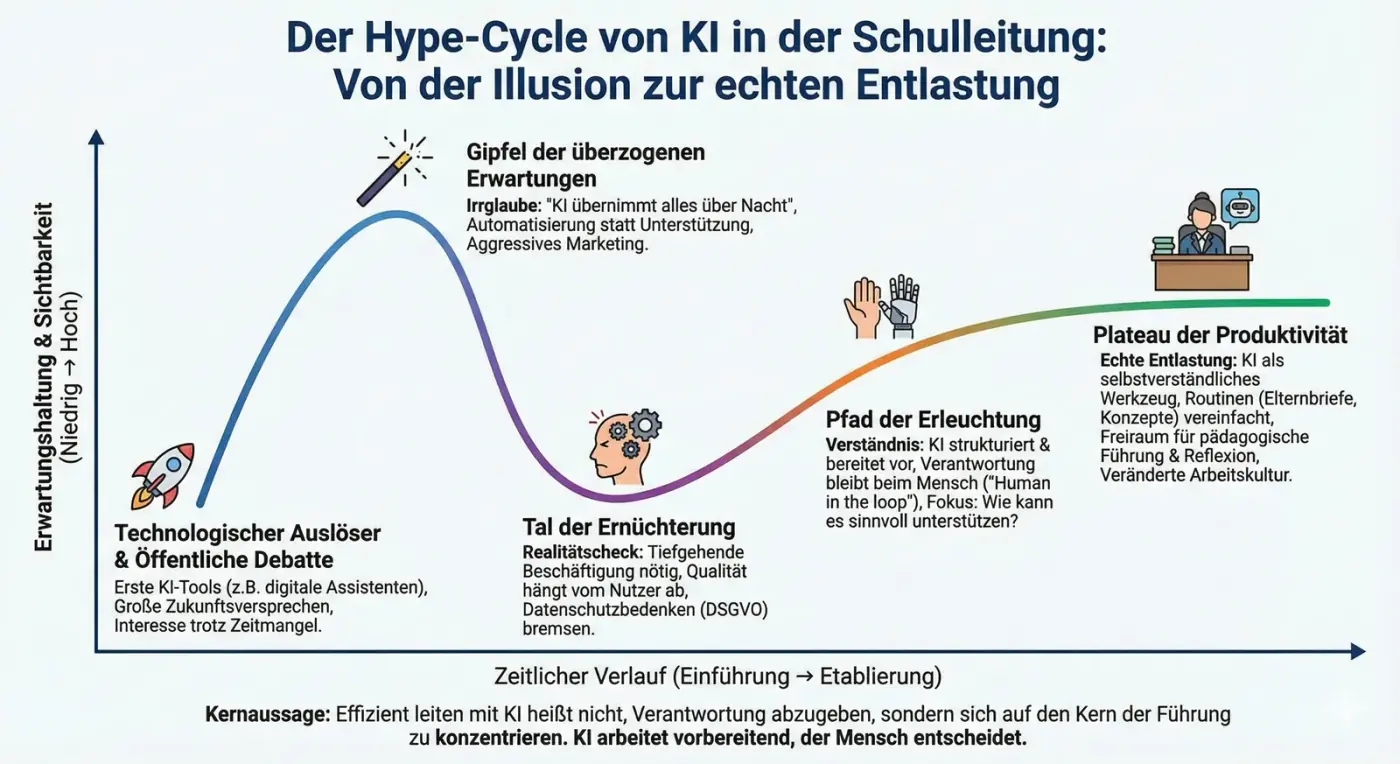
The frequently cited Gartner Hype Cycle describes a recurring pattern when new technologies are introduced into existing systems. With AI, expectations can be especially high: the technology is supposed to take over all work overnight, leaving school leaders or teachers with nothing to do. This narrative is reinforced by some voices in the education sector.
Disillusionment arrives quickly when it becomes clear that effective work with AI first requires a relatively deep understanding of the technology and that good results depend on the skill of the person using it.
If that experience instead creates a desire to use AI's genuine opportunities, a school can move through this “trough of disillusionment.” More realistic expectations and a clearer understanding of what AI can actually do in schools can then enable more effective use.
The larger lesson is that the greatest effect generally does not come from simply introducing individual applications. It comes from changing working practices and developing an appropriate mindset. Once AI is accepted as an ordinary tool, the focus shifts from “What is this supposed to achieve?” to “How can this meaningfully support me in practice?”
A small example might look like this:
School leadership makes an AI solution or platform with several options available to staff. Individual colleagues try their first assistants and other functions, then share their experiences with the wider team. They adapt assistants and demonstrate their use in short professional-development sessions. In this way, individual experiments can gradually become shared practice.
Conclusion: Workload reduction as a condition for leadership
AI does not make school leadership simple. Despite all the promises, it cannot assume responsibility for a complex system. That remains the responsibility of school leaders, with or without AI. At the same time, AI can reduce workload and support school leaders with recurring administrative tasks. Digital assistants are not ends in themselves. They are tools, and like all good tools, they become useful only when applied deliberately and thoughtfully.
AI can help by simplifying routines and creating room. At its best, that leaves more time for conversations, strategic thinking, and educational leadership. Leading efficiently with AI does not mean handing off responsibility. It means focusing on what leadership is fundamentally about: providing direction, making decisions, supporting people, and creating psychological safety for everyone in the system. That is especially important in the age of AI.
Related insights

AI Leadership Requires a New Digital Approach
Many school leaders sense that AI is changing schools, but few feel prepared. This article presents AI leadership as a mindset for navigating stability and change and introduces a practical AI competency model for school leadership.
Norman Graf5 min read
AI Monitor 2025: What Schools Actually Need Now
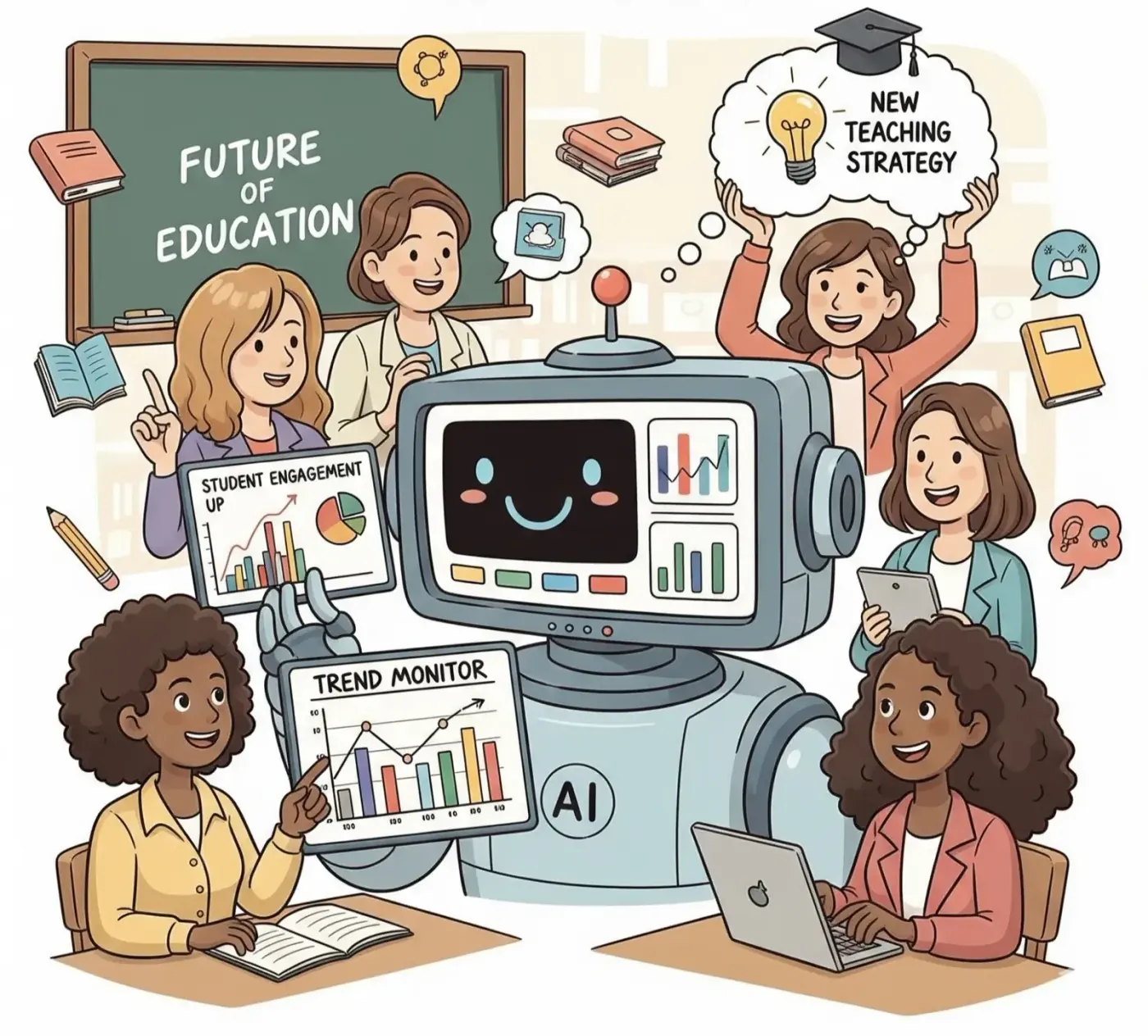
The Trendmonitor AI in Education 2025 shows: AI has arrived in everyday school life, but its potential is rarely used systematically. We summarize the key insights and show how Kipti supports schools.
Björn Schriewer4 min read

How to Prompt AI in Multidisciplinary School Teams
A practical guide to using AI systems effectively in everyday school life through targeted prompting. Learn how clear communication with AI systems can deliver better results for documentation, lesson preparation, and support planning.
Björn Schriewer11 min read