
AI Monitor 2025: What Schools Actually Need Now
The Trendmonitor AI in Education 2025 shows: AI has arrived in everyday school life, but its potential is rarely used systematically. We summarize the key insights and show how Kipti supports schools.
Björn Schriewer4 min read
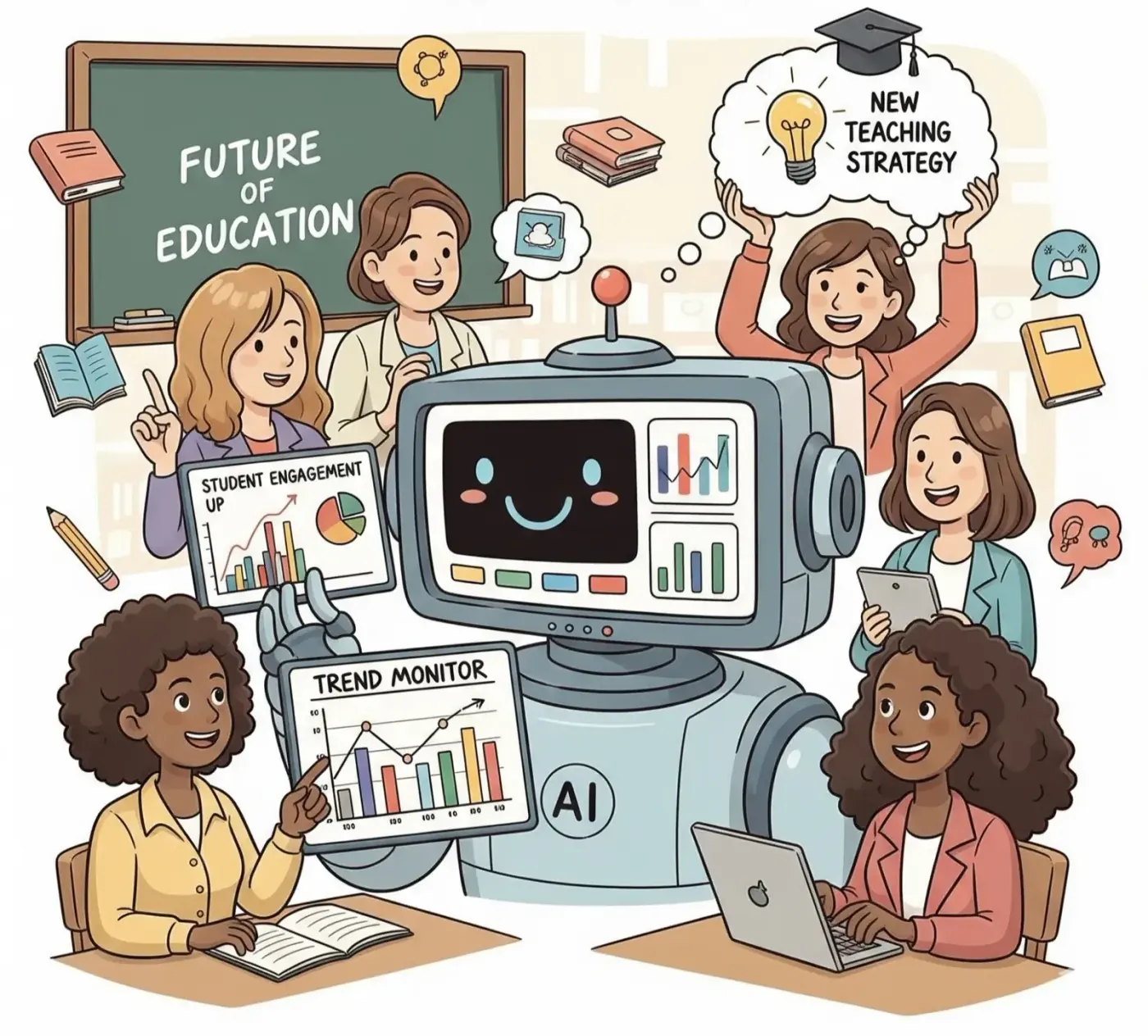
In Germany, education responsibilities and many implementation rules are set by the federal states, which shapes how schools can adopt AI.
The new Trendmonitor AI in Education 2025 paints a clear picture: AI has arrived in everyday school life in Germany – but its potential is not yet being realized systematically. This post summarizes the most important findings concisely, places them in a practical context, and shows how we are using KIPTI to support schools precisely where the report identifies the greatest levers.
The 5 central insights from the AI Monitor
-
Supply is exploding, use is lagging behind
Since 2021, the school-relevant AI offering in Germany has tripled. At the same time, schools continue to be dominated by experimenting with generative tools – systematically integrated scenarios are still the exception.
-
207 applications tracked – but gaps in school organization
The monitor's ongoing web research identifies 207 AI-supported applications; generative systems are growing particularly strongly. The area of school organization and administration remains clearly underserved, even though significant workload-relief effects would be possible here.
-
Teacher competencies are the lever
Whether AI succeeds stands and falls with the competencies of teachers: not just practical application skills, but a reflective approach, the ability to evaluate AI-generated content, and pedagogical integration are required.
-
Pragmatism in the framework – security without stagnation
The monitor advocates manageable rules and certification that do not stifle innovation – with an eye to the EU AI Act and data protection. Schools need legal clarity, but also room to shape their own approach.
-
More educational equity is possible
Adaptive learning pathways, feedback, and support with routine tasks create time for relationship-building and can reduce inequalities in opportunity – provided AI is pedagogically orchestrated in a meaningful way.
What does this mean concretely for schools?
1. Establish clear guidelines.
In October 2024, the KMK adopted policy recommendations for handling AI in schools – a good starting point for school-level frameworks (e.g., on assessment culture, transparency, data protection, and continuing professional development). Schools, municipalities, and states should adapt these to local circumstances and define their goals.
2. Build competencies – targeted and practice-oriented.
More than half of all teachers have already tried out AI; at the same time, there is a high demand for continuing professional development and widespread uncertainty about how to use it (Bitkom 2024/2025).
3. Create school-wide consistency.
Only 23% of schools have centralized AI guidelines – individual teachers often make decisions alone. Schools should establish uniform, learning-supportive procedures (e.g., for handling homework, citing sources, and providing feedback).
4. Relieve administration, strengthen teaching.
The monitor identifies the product gap in school organization. This is exactly where "quick wins" lie: digital documentation, knowledge access, summaries, standardized reports.
5. Anchor AI literacy as an educational goal.
Internationally, the focus on AI literacy is growing – the OECD emphasizes that the current offering of qualifications does not yet meet the demand for basic AI competencies; PISA 2029 is introducing Media & AI Literacy as a new assessment domain.
Our contribution: KIPTI (Alpha)
KIPTI is our platform for school knowledge management, designed to support GDPR-aligned use:
- Semantic search across notes and documentation – independent of exact wording.
- AI assistance for summaries, translations, plain-language simplifications, and draft suggestions for learning progress reports and support plans.
- Designed for multidisciplinary use – teachers, extended-day staff, school social workers, and others work within the same knowledge environment.
As of September 2025: Our alpha version was being piloted in 23 schools and developed further in partnership with them.
Start where the AI Monitor identifies the greatest levers – documentation, knowledge access, reports – and evaluate the impact of Kipti (time savings, quality, satisfaction).
Further sources
- Trendmonitor AI in Education 2025, Deutsche Telekom Stiftung (key findings on market, use, and policy recommendations).
- KMK (10/2024): Policy recommendations on the use of AI in school education.
- Bitkom (2024/2025): Use, rules, and continuing professional development interest among teachers and schools.
- OECD (2025): Bridging the AI Skills Gap; PISA 2029 MAIL (Media & AI Literacy).
Related insights

AI in Schools: Opportunities and Risks
AI is already part of everyday school life. This article examines opportunities and risks for learning, teachers, and the selection of appropriate systems.
Sina Schriewer9 min read

AI in Schools 2026: Better Models, Better Education?
New AI models are growing more capable, but better education only emerges through clear frameworks, pedagogical responsibility, and the right deployment scenarios.
Björn Schriewer7 min read
How to Prompt AI in Multidisciplinary School Teams
A practical guide to using AI systems effectively in everyday school life through targeted prompting. Learn how clear communication with AI systems can deliver better results for documentation, lesson preparation, and support planning.
Björn Schriewer11 min read