AI in Schools 2026: Better Models, Better Education?
New AI models are growing more capable, but better education only emerges through clear frameworks, pedagogical responsibility, and the right deployment scenarios.
Björn Schriewer7 min read

Artificial intelligence is changing rapidly. Just a few years ago, chatbots were the main focus: systems that write texts, answer questions, or draft worksheets. Today, AI systems solve complex mathematical problems, support research teams, and are even beginning to assess their own uncertainty more accurately. Google DeepMind describes Gemini Deep Think as a scientific companion for mathematics, physics, and computer science. (Google DeepMind)
For schools, this sounds like a technological success story. More capable AI could prepare lessons, support learning progress reports and support plans, structure student observations, or relieve teachers of documentation work. But in education, the question "What can AI do?" is not enough. The decisive question is a different one: What does AI do to learning, to pedagogical responsibility, and to the trust placed in schools?
The OECD examined exactly this question systematically in a dedicated study in January 2026 – and its answer gives schools a surprisingly clear framework.
What does OECD guidance say about school AI?
The OECD's Digital Education Outlook 2026 is an international stocktaking of generative AI in education. The Centre for Educational Research and Innovation (CERI) compiled research and practice from across the OECD member countries. The central message: AI in school is not a binary question. It is not about whether AI is used, but in what configuration – and who bears what responsibility. (OECD)
The study distinguishes three deployment scenarios in the classroom:
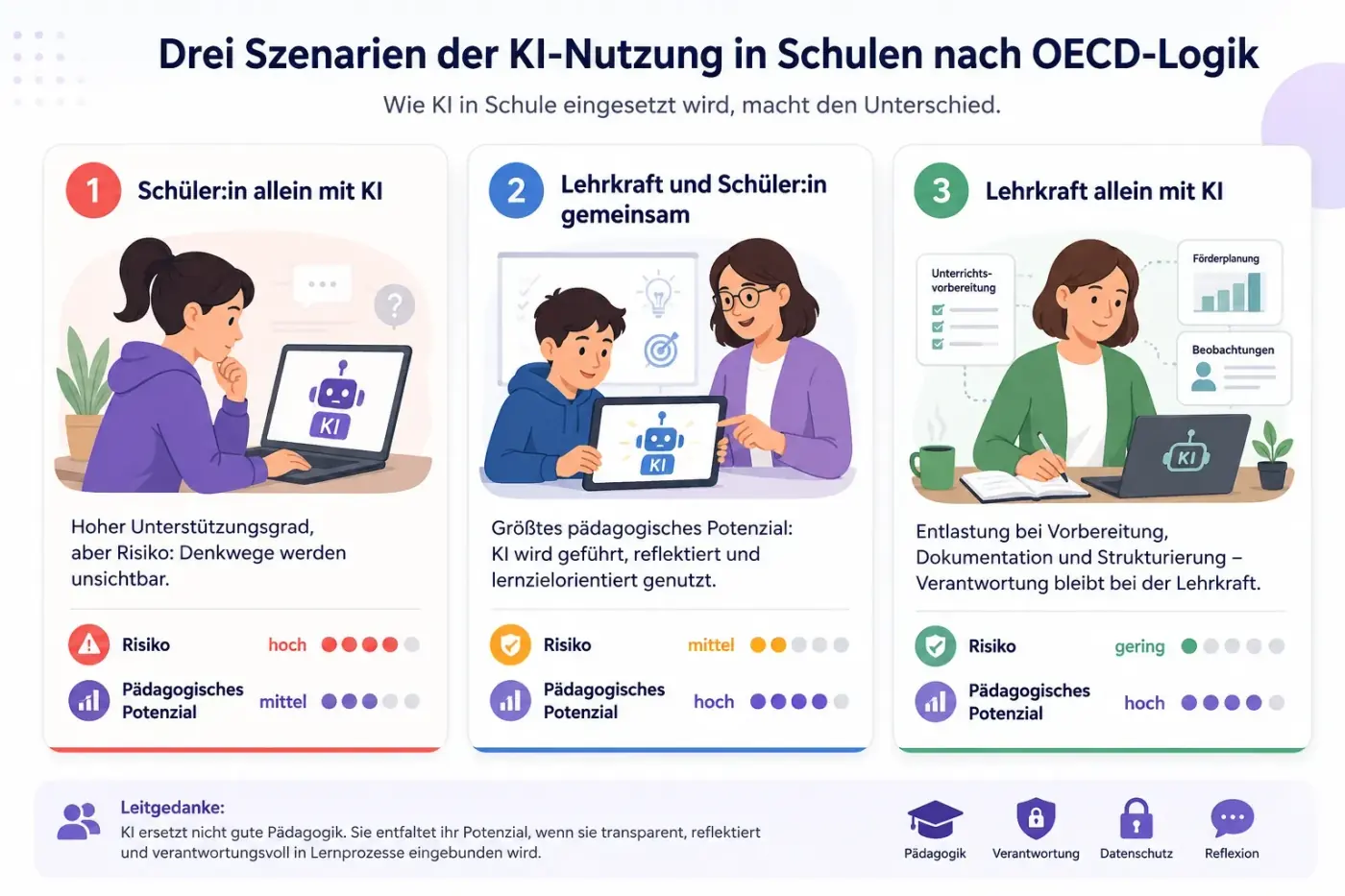
Scenario 1: Students use AI alone to learn subject content. This is the scenario with the greatest risk. When a model formulates a solution without the student following the path to get there, the result can look better without learning actually improving. The OECD warns clearly against outsourcing cognitive work to general-purpose chatbots. Effort, persistence, metacognition, and deep understanding are weakened in the process – precisely the capacities that constitute genuine learning.
Scenario 2: Teachers and students use AI together in the classroom. This is where the OECD sees the greatest pedagogical potential. AI becomes a tool deployed under pedagogical guidance – with clear learning objectives, reflection, and a teacher who can judge when AI helps and when it distracts. The output is no longer the goal; the learning path remains it.
Scenario 3: Teachers use AI alone to support their work. Lesson preparation, differentiation, documentation, support plans, observations – here, AI can provide teachers with meaningful relief. Pedagogical responsibility remains entirely with the teacher; the risk to learners is low. Provided the systems are transparent, data-minimal, and auditable.
The key insight: the same AI is a different tool in each scenario. What means relief in the third scenario can hollow out the learning experience in the first. A school AI strategy that fails to distinguish between these scenarios will not succeed.
Why does learning still need friction?
A fitting echo from research: a recent Nature correspondence describes how AI agents make research teams more productive while simultaneously depriving early-career researchers of opportunities to develop foundational skills through their own doing. The title gets straight to the point: productivity may come at the cost of "apprenticeship" – professional formation through practice. (Nature)
Learning is itself a form of apprenticeship. Children and young people do not develop competence by seeing finished results. They develop competence by searching, failing, correcting, comparing, discussing, and trying again. This friction can disappear unnoticed in Scenario 1: when answers are simply adopted, no friction occurs – and thus no learning process. Scenario 2 must protect exactly that.
Good AI in education therefore does not simply deliver the answer. It asks questions, structures lines of thinking, flags uncertainties, surfaces alternatives, and helps teachers understand student progress more clearly.
Why must AI show its own uncertainty?
This requires, however, that AI knows its own limits – and can communicate them. MIT researchers have introduced RLCR (Reinforcement Learning with Calibration Rewards), a training method that prompts models to output a calibrated self-assessment of their own confidence alongside any answer. In tests, this self-assessment aligned with reality considerably better afterward: when a model expressed confidence, it was now also more frequently correct. The gap between stated and actual confidence shrank by up to 90 percent, without the answers themselves becoming worse. (MIT News)
For schools, this is more than a technical detail. Confidently wrong answers are particularly problematic here. An AI that is uncertain but sounds authoritative generates trust precisely where skepticism would be warranted. More valuable would be an AI that says: "I am uncertain here," "This information should be verified," or "The data needed for this assessment is missing."
Especially on sensitive topics such as support needs, child protection, reasonable accommodations, or parent communication, AI must not produce the appearance of certainty. It must be auditable, verifiable, and bounded.
What rules do schools need for AI?
Stanford HAI notes in the AI Index 2026 that AI capabilities are growing faster than societies can measure, regulate, and understand them. Four out of five US high-school and college students use AI for schoolwork. Only half of middle and high schools have AI policies, and only six percent of teachers describe those policies as clear. (Stanford HAI)
In Germany, where education is governed by the individual federal states, schools face the same challenge: the usage is already there, but a shared language is often still missing. What counts as permitted assistance? What is deception? When is AI a learning partner, when a shortcut tool?
If a teaching staff cannot answer these questions, students are already using AI differently from how teachers assume.
In Europe, the AI Act adds a further layer – a risk-based legal framework for trustworthy AI. Particularly relevant for schools: emotion recognition in educational institutions is among the prohibited practices; certain AI systems used for assessment, selection, or profiling in education are classified as high-risk and will be regulated with increasing stringency. Transparency obligations for AI systems that interact directly with users took effect from August 2, 2026. Prohibitions and AI competency obligations have already applied since February 2, 2025. UNESCO complements this framework with a human-centered approach: data protection, age-appropriate use, and ethical review. (Digital Strategy, Article 50 AI Act, UNESCO)
What does the OECD framework mean for schools?
Three practical principles can be derived from the three OECD scenarios, each tailored to a different configuration.
First: Student-only use requires learning design, not just prohibition. If AI can replace thinking, instruction must be designed so that the learning path remains visible. Tasks that only assess the end result come under pressure. Tasks that incorporate reflection, justification, and process gain in importance.
Second: Joint use requires teacher competency. For AI to be deployed under pedagogical guidance in the classroom, teachers need to understand what AI does and where it fails. AI literacy is therefore not an additional competency but part of modern pedagogical practice.
Third: Teacher-only use requires data-minimal, transparent tools. When preparing lessons and working on documentation, teachers handle sensitive data. AI tools in this area must bring data protection, auditability, and data minimization as non-negotiable features. (MIT News)
What does this mean for Kipti?
Kipti is clearly positioned in the third scenario. We build for teachers who document their work, structure learning progress, and collaborate in multi-professional teams. That is exactly the scenario in which the OECD study sees strong potential for relief – and in which the risk for learners is lowest, when the tools remain transparent and bounded. You can find more on our page Using AI in schools with data protection in mind and in the Kipti FAQ.
Multi-professional teams do not need a black box that replaces pedagogical judgment. They need systems that simplify documentation, make relevant information findable, structure collaboration, and prepare decisions in a way that is auditable.
The real question for the future is therefore not: "How much AI can we bring into schools?" But rather: In which scenario, with what limits, with what accountability?
AI can be a learning partner, an assistant, and a structural aid. It should not become a substitute for thinking, relationships, and professional judgment.
In the end, the issue is not whether schools use AI. They already do. The question is whether they use AI by accident – or shape it deliberately.
Sources and further reading
- Google DeepMind: Gemini Deep Think
- OECD Digital Education Outlook 2026
- Nature: AI agents in research
- MIT News: Teaching AI models to say 'I'm not sure'
- Stanford HAI: AI Index 2026 - Education
- European Commission: AI Act
- AI Act Service Desk: Article 50
- UNESCO: Guidance for generative AI in education and research
- MIT News: Privacy-preserving AI training
Related insights

AI in Schools: Opportunities and Risks
AI is already part of everyday school life. This article examines opportunities and risks for learning, teachers, and the selection of appropriate systems.
Sina Schriewer9 min read
Prompt Injection: Why It Matters in Education
Prompt injection is a central weakness in AI systems. This article examines risks, current research, and protective measures for education.
Björn Schriewer8 min read
Google "Learn Your Way": An Adaptive Textbook?
Google Labs is testing Learn Your Way, an AI-assisted textbook experiment that personalizes content and translates it into different learning formats. We examine its architecture, educational foundations, and reported outcomes.
Björn Schriewer9 min read