
AI in Schools: Opportunities and Risks
AI is already part of everyday school life. This article examines opportunities and risks for learning, teachers, and the selection of appropriate systems.
Sina Schriewer9 min read

Artificial intelligence is already part of everyday school life. Current figures show how naturally students and teachers now use AI. This makes the decisive question less and less whether AI should play a role in schools, and more about how its opportunities can be used meaningfully and possible risks can be kept in check.
In Germany, education policy is set by the federal states, and the Kultusministerkonferenz (KMK) – Germany's Standing Conference of the Ministers of Education and Cultural Affairs – issues cross-state recommendations that shape how schools approach new topics including AI.
According to the JIM-Studie 2025, 74 percent of 12- to 19-year-olds already use AI applications for homework or learning. Among teachers, usage is also growing. According to a recent Bitkom survey, 58 percent use AI for school-related purposes. Two thirds of teachers see AI as fundamentally an opportunity for school education.
This shifts a central question. Schools no longer need to decide in principle whether AI should play a role. They need to clarify where AI provides meaningful support, where limits lie, and what opportunities arise from this – both for learning and for simplifying school workflows.
AI can take on very different roles in schools. It can support students in learning, relieve teachers in lesson preparation, simplify administrative processes, or support collaboration in multi-professional teams. At the same time, new questions arise around learning processes, data protection, responsibility, and confident AI use.
AI opportunities: personalize learning
One of the great potentials of AI lies in supporting learning processes.
64 percent of teachers surveyed by Bitkom say that digital technologies enable them to respond more individually to students. AI can extend these possibilities. Texts can be adapted to different language or performance levels, tasks can be varied, or content can be explained in different ways.
New possibilities also open up for inclusion and language participation. Content can be simplified, translated, or prepared differently. What remains decisive is that the teacher classifies the use pedagogically and decides when the support is genuinely useful.
That confident AI use itself becomes an educational task is a view now shared by many teachers. 89 percent of those surveyed by Bitkom believe that students should learn how to use AI.
A helpful orientation framework is Joscha Falck's "Learning and AI" model. It distinguishes five dimensions: learning about, with, through, despite, and without AI. The model describes different perspectives on learning and teaching in a world shaped by AI. It is not just about using AI as a tool, but also understanding how it works, critically reflecting on its outputs, and deliberately creating learning opportunities in which AI is not used.
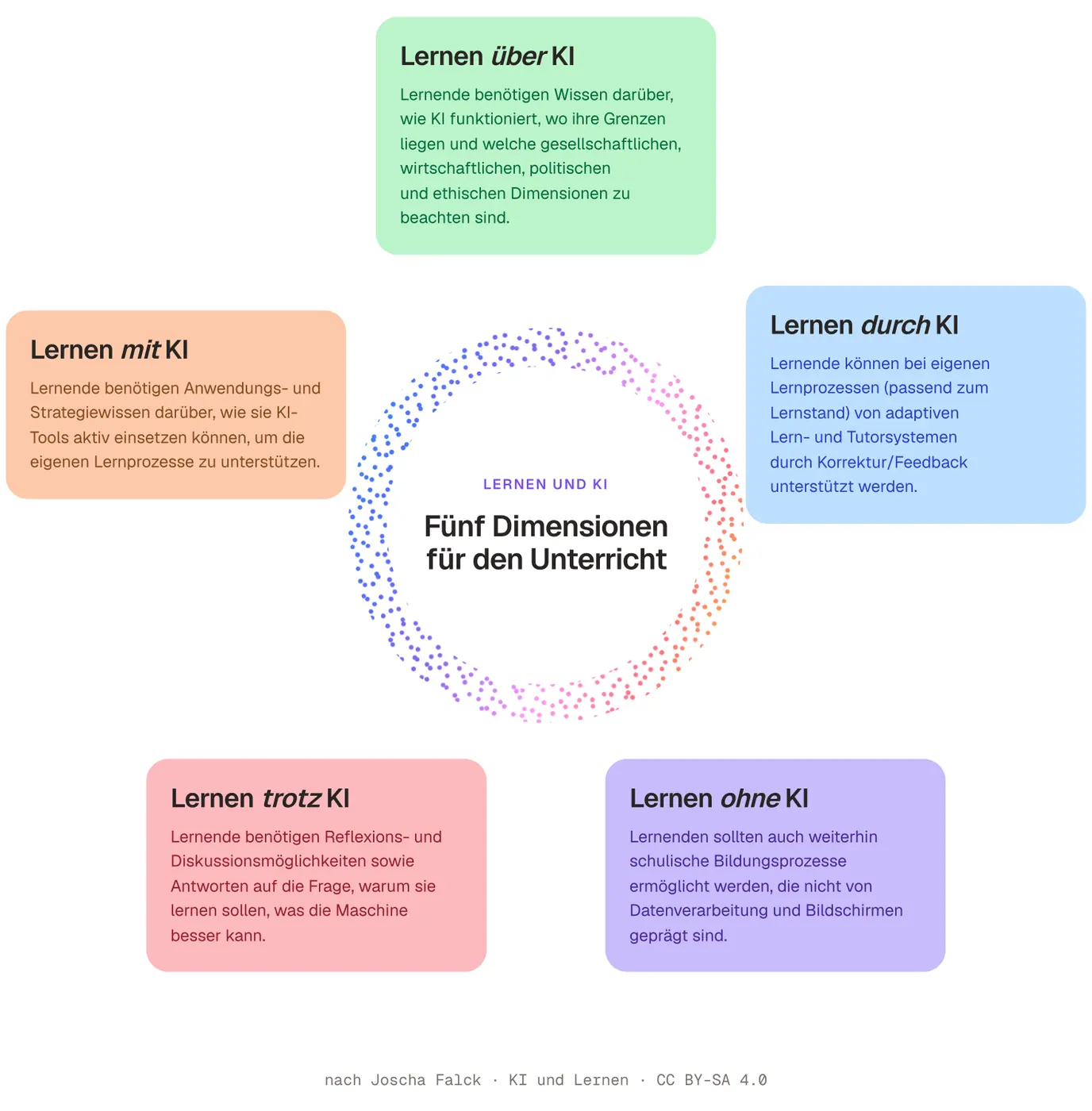
View graphic at full size · Graphic: Joscha Falck, "Learning and AI", CC BY-SA 4.0.
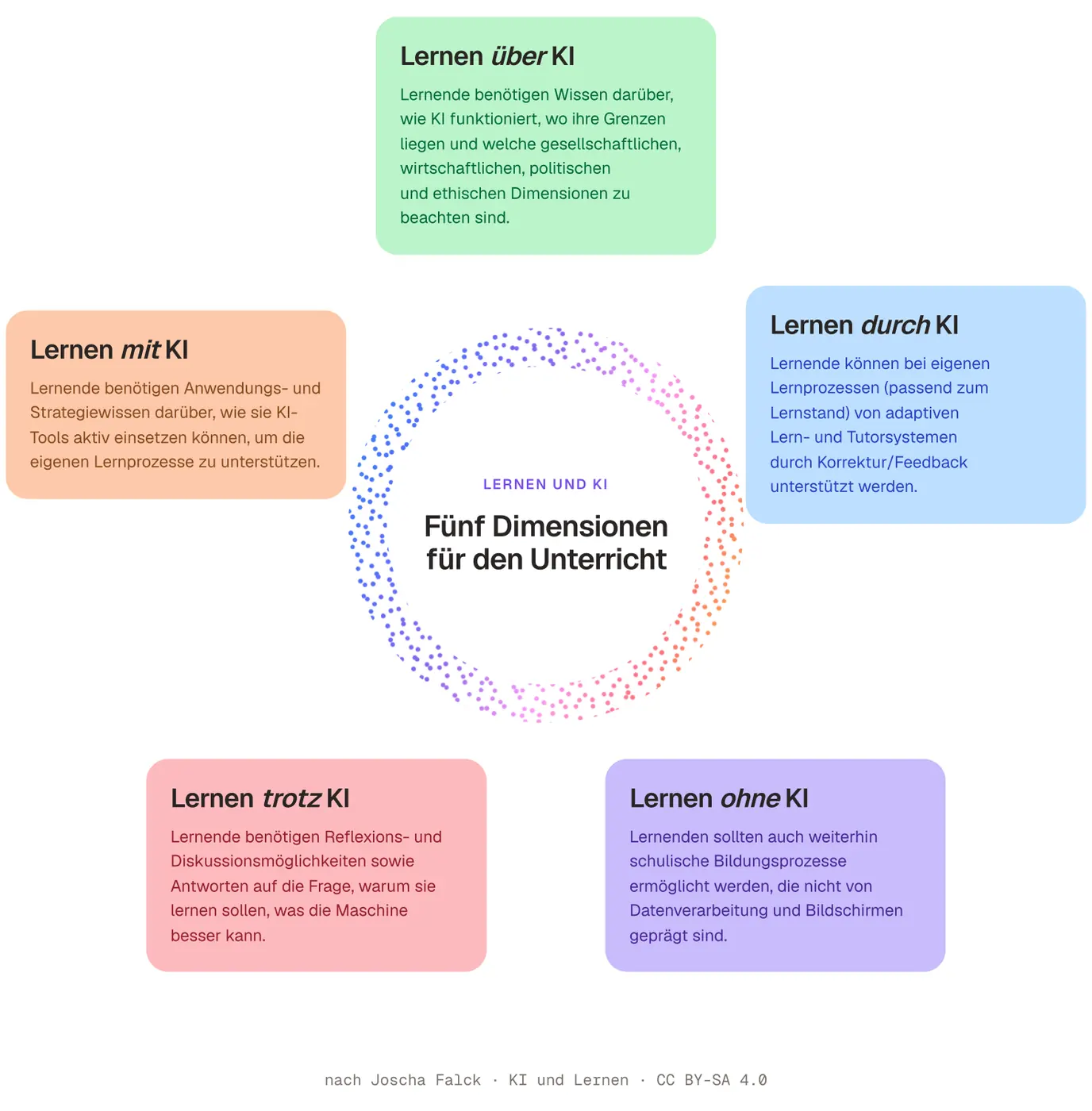
This makes clear: meaningful AI use does not mean completing as many tasks as possible with AI. What matters is when AI supports the learning process and when it might actually hinder it.
AI risks: when support replaces thinking
This is exactly where one of the central risks lies.
42 percent of teachers surveyed by Bitkom express concern that AI could impair students' independent thinking.
That this concern is not unfounded is shown by a study on the use of generative AI in mathematics instruction involving nearly 1,000 students.
During the practice phase, students with largely unrestricted AI access achieved better results. When they were subsequently tested without AI, however, they performed 17 percent worse than the control group, which had worked without AI beforehand.
A second finding from the study is also notable. With an AI specifically designed as a tutor – one that worked more with hints and did not simply hand over solutions – this negative effect was not observed in the same way.
This shows that the decisive question is not whether AI is used, but how it is designed and integrated into the learning process.
AI in learning should therefore not function like an elevator that transports students directly to the result. A more useful image is that of a climbing harness: AI can provide support, offer hints, and create a sense of safety, while the actual thinking and learning effort remains with the students.
The ability to assess AI outputs critically becomes all the more important. According to the JIM-Studie 2025, 57 percent of young people consider information provided by AI to be trustworthy. Checking sources, questioning claims, and identifying potential errors therefore becomes an important part of AI competency.
AI for teachers: everyday relief
The opportunities of AI are not limited to student learning.
Teachers can also use AI to ease their working day. According to Bitkom, 82 percent of teachers cite their own overload as one of the most pressing problems at their school. At the same time, around one in three teachers already say that AI makes their working day easier.
One obvious area is lesson preparation. A growing number of applications are available here, supporting tasks such as creating teaching materials, formulating assignments, or differentiating content.
But school consists of considerably more than lesson preparation.
AI can also offer potential for many organizational and administrative tasks – for example, preparing parent meetings, letters to parents, learning progress reports, or support plans. Further conceivable applications include support with conference minutes, the documentation of oral assessments where the legal conditions are met, structuring large amounts of information, or preparing handoffs and case discussions.
AI can also be interesting for multi-professional collaboration. In Germany, teachers, extended-day staff (Ganztag), school social workers, special education professionals, and further specialists increasingly work together with the same students. Observations, agreements, tasks, and information are generated at various points and needed again later.
AI can help structure existing knowledge more quickly, summarize it, and make it usable for further work.
Which of these possibilities is actually relevant for a given school cannot be answered in general terms.
Teachers and other staff members should therefore first look at their own working day: Which processes take up particularly large amounts of time? Which tasks repeat themselves constantly? Where is energy unnecessarily lost?
Only then does it make sense to ask whether AI can provide meaningful support here and what solutions already exist. It can also be worthwhile to speak with providers or young companies. Especially in a rapidly developing market, new and highly specific solutions are emerging all the time, and it is possible that someone is already working on a concrete problem.
Risks and challenges: when clear frameworks are missing
As AI use increases, new organizational and legal challenges arise alongside it.
According to Bitkom, only 46 percent of teachers are provided with an AI license or account by their school. At the same time, 26 percent use private AI accounts for school-related purposes, either in addition to or exclusively instead of school-provided ones. 58 percent of teachers feel uncertain in their use of AI.
This reveals a fundamental problem: when schools do not provide appropriate tools and frameworks, individual solutions emerge. Individual staff members find their own tools, develop their own working methods, and must judge for themselves which information they are permitted to enter into which systems.
Particularly with personal and sensitive information, this can become problematic.
Added to this is the question of which decisions may at all be prepared or made with the help of AI, and what requirements apply to each type of use.
This is why it is worthwhile to clarify some fundamental questions before introducing an AI system.
What schools should look for when selecting AI
Not every school needs the same solution, and not every use case places the same demands. What matters first is clarity about what AI should be used for and what a suitable solution must deliver.
1. What problem should be solved?
The starting point should not be the tool but the actual need.
Should AI support learning, ease lesson preparation, simplify administrative tasks, reduce documentation work, or improve collaboration?
The more precisely a school knows what challenge it wants to address, the better it can judge which solution is genuinely suitable.
2. What information will be processed?
The requirements differ considerably depending on what data is processed in a system.
A teacher developing general lesson ideas works with different information from one who is processing observations about individual students, conversation notes, or support-related information.
Data protection, storage location, access rights, and the further processing of entered data should therefore always be reviewed in line with the specific use case.
3. What legal requirements apply?
Here too, the specific use case is decisive.
The European AI Act takes a risk-based approach. This means that not every AI application is subject to the same requirements. For certain applications in the education sector, however, special rules apply – for example, when AI systems are used for certain assessment or selection decisions.
The recommendations of the Kultusministerkonferenz on handling AI in school education processes also emphasize a constructively critical engagement with AI and the importance of clear legal frameworks.
Before selecting a solution, it should therefore be clarified what requirements arise from the specific use and how it is ensured that professional and pedagogical responsibility remains with people.
4. Who will use the AI?
Schools are large organizations in which very different people and professional groups work.
An AI solution may support only school leadership, be designed for individual departments, or relieve teachers of specific tasks. But it may also concern the entire teaching staff or a multi-professional team made up of teachers, extended-day staff, school social workers, and further educational professionals.
This decision should be made as early as possible. Because depending on who uses a system, the requirements for access rights, roles, collaboration, and usability all change.
5. What resources are available?
Finally, a school should take a realistic look at what resources are available for an introduction.
These include financial resources for licenses and technical infrastructure, as well as staffing. Who will support the rollout? What professional development is needed? Who can assist with questions?
A capable AI system brings little benefit if its introduction creates additional burden in everyday school life or if it stops being used after a short time.
Conclusion: seizing opportunities, managing risks deliberately
AI has arrived in schools – among students and teachers alike.
This creates new possibilities; at the same time, responsibility increases.
For learning, this means deploying AI in a way that supports learning processes without replacing independent thinking. Students must learn to question AI outputs critically and to use the technology consciously.
For the work of teachers and multi-professional teams, it means using AI in a way that provides relief where particularly large amounts of time are lost, processes are unnecessarily complicated, or similar work recurs constantly.
At the same time, clear frameworks for data protection, accountability, and the selection of appropriate systems are needed.
The decisive task for schools is therefore not to introduce as many AI tools as quickly as possible. It is to understand opportunities and risks, know their own needs, and decide deliberately where AI can create genuine added value for learning and everyday school life.
Sources and further reading
- Bitkom: Schule und KI - Große Chancen, ungleiche Voraussetzungen
- Medienpädagogischer Forschungsverbund Südwest: JIM-Studie 2025
- Bastani et al.: Generative AI without guardrails can harm learning
- Joscha Falck: Lernen und Künstliche Intelligenz
- European Union: Regulation (EU) 2024/1689 (AI Act)
- Kultusministerkonferenz: Handlungsempfehlung zum Umgang mit KI
Related insights

AI in Schools 2026: Better Models, Better Education?
New AI models are growing more capable, but better education only emerges through clear frameworks, pedagogical responsibility, and the right deployment scenarios.
Björn Schriewer7 min read
AI Monitor 2025: What Schools Actually Need Now
The Trendmonitor AI in Education 2025 shows: AI has arrived in everyday school life, but its potential is rarely used systematically. We summarize the key insights and show how Kipti supports schools.
Björn Schriewer4 min read
Prompt Injection: Why It Matters in Education
Prompt injection is a central weakness in AI systems. This article examines risks, current research, and protective measures for education.
Björn Schriewer8 min read