Google "Learn Your Way": An Adaptive Textbook?
Google Labs is testing Learn Your Way, an AI-assisted textbook experiment that personalizes content and translates it into different learning formats. We examine its architecture, educational foundations, and reported outcomes.
Björn Schriewer9 min read
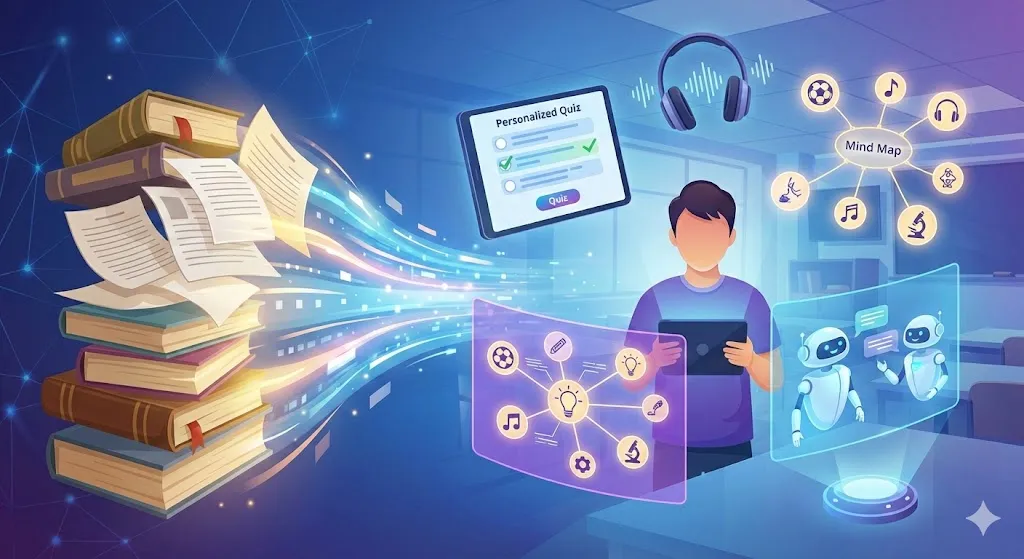
Textbooks remain one of education's most stable interfaces: linear, dependable, and tied to a curriculum. At the same time, they are products of another era: one-size-fits-all, minimally adaptive, and rarely multimodal. Every additional explanation, visualization, or practice activity demands substantial author time.
A new Google Labs experiment enters this gap: Learn Your Way (Google, n.d.). It comes not only with a demo, but also with a technical report that includes an evaluation and randomized study: “Towards an AI-Augmented Textbook” (LearnLM Team, 2025). A separate experimental paper provides more granular study details (Heldreth et al., 2025).
As a computer scientist and the founder of an EdTech company, I look at systems like this through two lenses:
- What is genuinely new—and scalable—about the technology?
- Which parts are educationally sound—and measurably effective?
What makes the project interesting is Google's relatively consistent effort to bring both perspectives together.
What exactly is Learn Your Way?
Learn Your Way is an interactive Google Labs experiment designed to transform textbook or PDF content into a dynamic, adaptable learning environment (Google, n.d.; Elidan & Haramaty, 2025).
The demo uses content from OpenStax, whose textbooks are freely available, and includes a waitlist for uploading custom PDFs (Google, n.d.; OpenStax, n.d.).
At its core, the system does the following:
- The learner selects parameters such as grade level and interests, including sports, music, or food.
- The system adapts the text through re-leveling and replaces examples to make them more personally relevant, while aiming to preserve the core subject matter.
- From this personalized source text, it generates several views of the same material and adds practice activities and checks (LearnLM Team, 2025; Elidan & Haramaty, 2025).
Google describes these views as including (Elidan & Haramaty, 2025):
- Immersive text: The original text is divided into manageable sections and enriched with generated images and embedded comprehension questions.
- Section-level quizzes: Brief comprehension checks after each section.
- Slides and narration: A presentation with activities and a narrated explanation.
- Audio lesson: A conversational audio explanation in a question-and-answer format, described by Google as a “teacher–student dialogue.”
- Mind map: A hierarchical structure that learners can zoom into and out of.
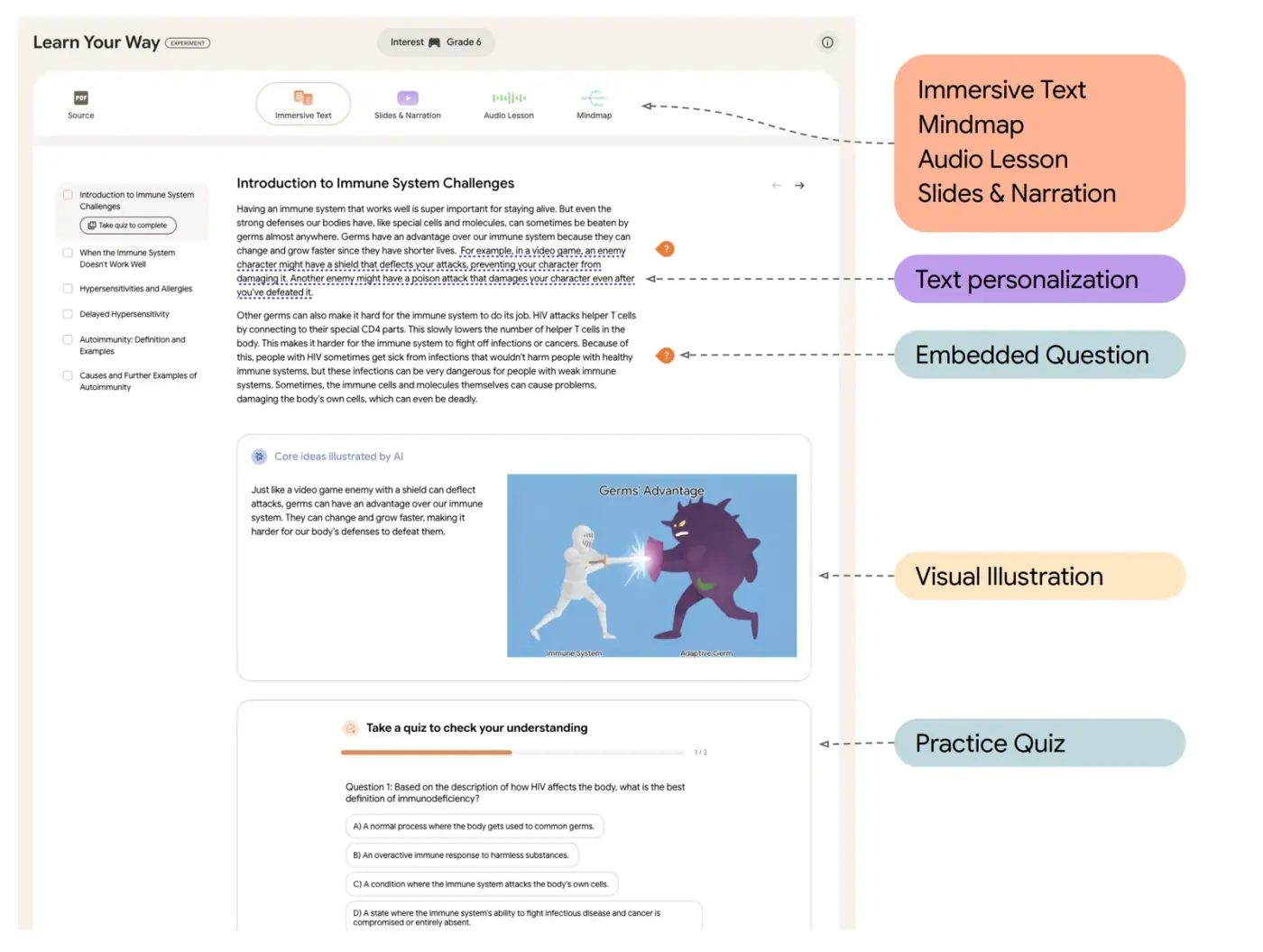
Importantly, this is not simply a chatbot attached to a PDF. It is closer to a workflow that translates the same content into several learning artifacts through an explicit pipeline (LearnLM Team, 2025).
What is technically interesting about it?
Many generative-AI learning products work roughly like this: give content to a large language model and hope that education emerges from the output. Learn Your Way reverses that logic: the educational design is the product; models are components.
The technical report describes a pipeline in which source text is first personalized or transformed and then used to generate consistent views such as text, audio, slides, and a mind map (LearnLM Team, 2025).
From a systems perspective, it is a content compiler:
- Input: Curated source text from a textbook or PDF.
- Transformation layer: Grade-level rewriting and example substitution for personalization.
- Views: Mind map, audio, slides, immersive text, and questions.
- Feedback signal: Quizzes as formative checks and navigation support.
That may sound straightforward, but the distinction matters. Instead of having each feature generate its own version, the views share a controlled core text. The report argues that this approach reduces inconsistencies across formats (LearnLM Team, 2025).
Two Foundations: Representation, Personalization, and Integrity
The technical report describes a clear product goal: textbooks are dependable but inflexible, while alternative explanations, examples, and media are expensive to create. Generative AI could make those variations scalable if content integrity and quality are maintained (LearnLM Team, 2025).
1. Multiple representations: Multimodality and variation
The idea is that learners are more likely to develop robust mental models when they process a concept through more than one representation. Google's accompanying research article explicitly cites dual coding as a motivation (Elidan & Haramaty, 2025); Paivio's dual-coding theory is a classic theoretical reference (Paivio, 1991).
In practice, Learn Your Way translates this principle into choices: text, audio, slides, a mind map, and embedded questions (Elidan & Haramaty, 2025; LearnLM Team, 2025).
2. Personalization with a “source of truth” goal
Personalization takes place along two dimensions (LearnLM Team, 2025):
- Grade-level re-leveling: The text is rewritten for a target level. The paper discusses Flesch–Kincaid as one reference measure in the context of grade-level adaptation (LearnLM Team, 2025).
- Interest-based examples: Passages are selectively adapted to connect with prior knowledge or interests, while aiming to preserve the core content (LearnLM Team, 2025).
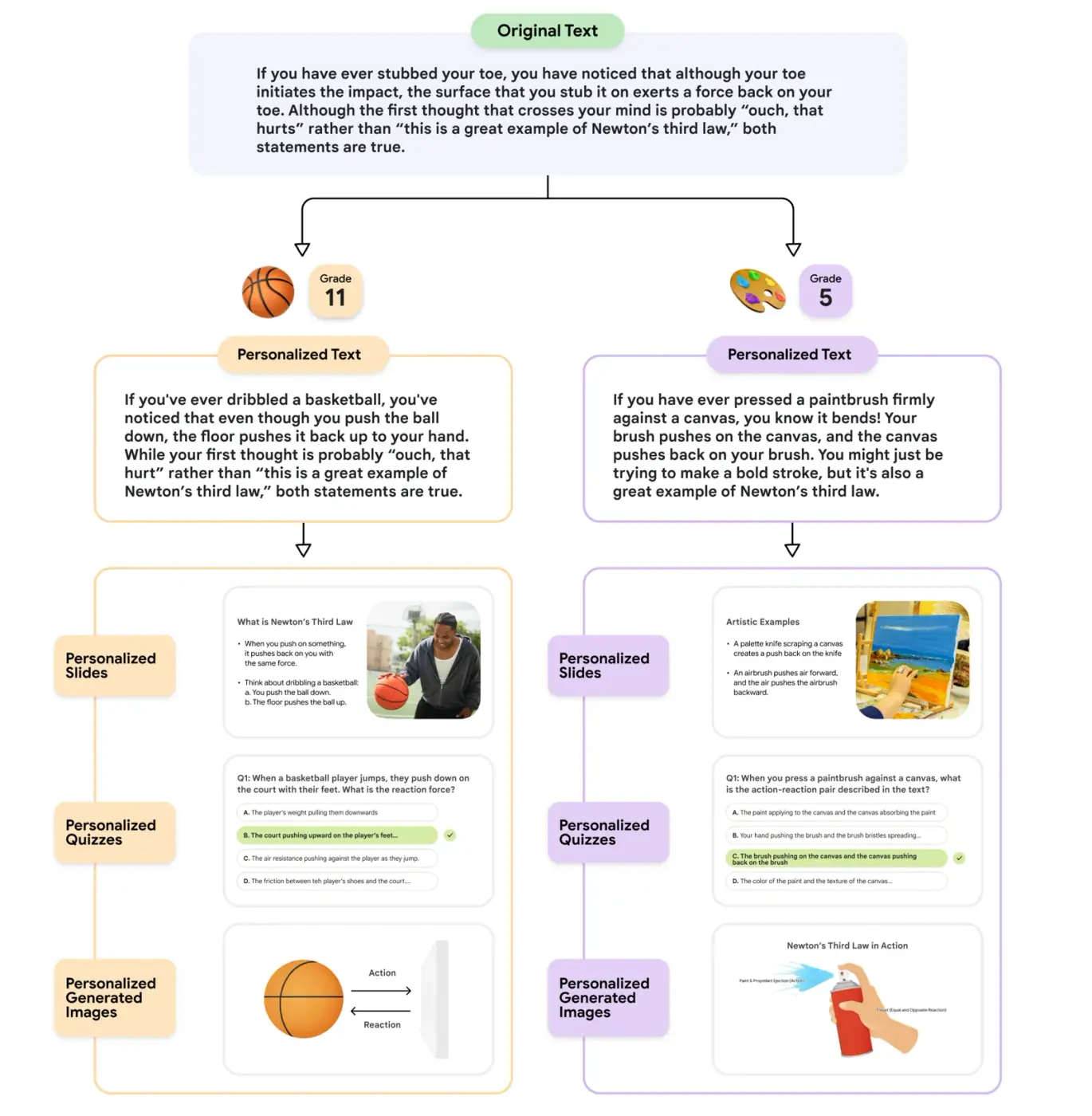
The order of the pipeline is important. Personalization happens first, and the different content views are then generated from that result. This is intended to keep personalization more consistent across formats (LearnLM Team, 2025).
Evaluation: Reported measurements, not only a promising idea
Google reports two kinds of evidence:
1. Educational and expert evaluations
The technical report describes expert evaluations of the transformations and views against criteria such as accuracy and coverage (LearnLM Team, 2025). Experts evaluated generated views including slides, audio, and mind maps across several educational criteria. According to the Google Research article, average scores were 0.85 or higher, which Google characterizes as “highly positive” (Elidan & Haramaty, 2025).
2. Randomized controlled trial
The technical report describes a randomized study comparing Learn Your Way with a standard digital reader and reports better overall retention outcomes for Learn Your Way (LearnLM Team, 2025). The Google Research article gives the effect as an 11-percentage-point increase on retention tests relative to a standard digital reader (Elidan & Haramaty, 2025).
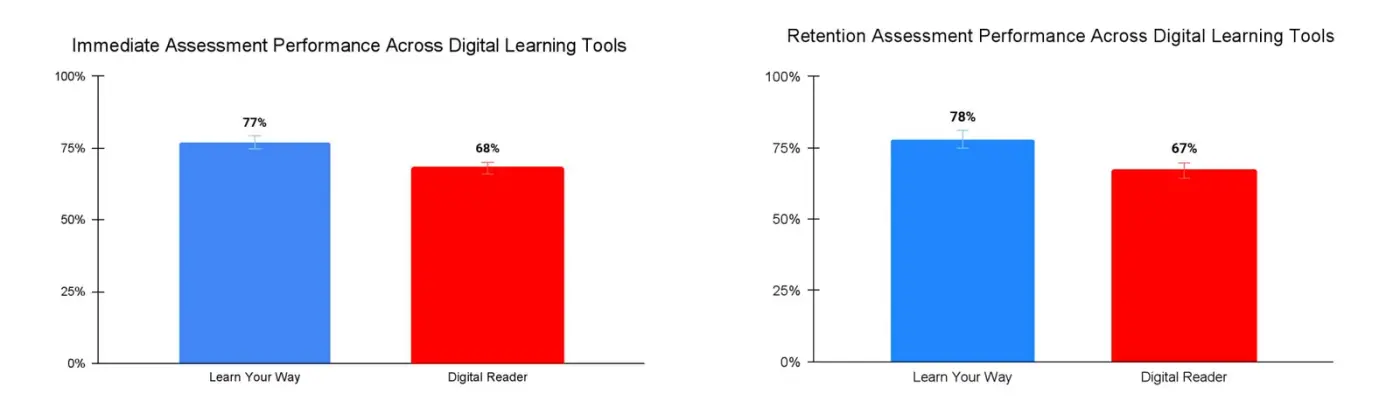
The separate experimental paper provides further detail about the study setup, including its sample and design, and also reports advantages for the Learn Your Way condition compared with a digital or PDF reader (Heldreth et al., 2025).
This is not definitive proof that AI textbooks outperform every alternative. It is, however, more substantive than a typical product announcement.
Three things Learn Your Way does particularly well
1. Product Form Matters More Than Models
Many AI-for-learning approaches reduce to a request that a language model explain something. Learn Your Way instead defines learning artifacts—text, quizzes, slides, audio, and mind maps—and has a system generate those artifacts in a controlled way from a source of truth (LearnLM Team, 2025).
That makes it a useful reference architecture for AI-assisted learning products, particularly when scale matters.
2. Content integrity as a design principle
For EdTech, especially in schools, the central problem is not creativity but dependability: alignment with the curriculum, factual accuracy, and avoiding silent drift. The technical report explicitly targets this problem by generating alternative representations without changing the core subject matter (LearnLM Team, 2025).
3. Multimodal, with realistic constraints
Google's research article notes that educational illustrations have distinct requirements and describes specialized model and training decisions for them (Elidan & Haramaty, 2025). That aligns with a common experience in learning products: colorful pictures are easy; useful learning visualizations are hard.
Will Learn Your Way Revolutionize Education?
The tempting conclusion is that textbooks are finally no longer boring. That may be true, but pleasant to consume does not automatically mean effectively learned.
Three lines of research are especially relevant:
1. Feeling Good Can Signal Illusory Learning
In a well-known controlled comparison, students learned more objectively through active instruction while feeling that they had learned less (Deslauriers et al., 2019). One plausible explanation is that cognitive ease, or fluency, is easily mistaken for competence.
Applied to Learn Your Way:
Personalized text, relevant examples, slides, and audio can increase fluency. That may support motivation and lower barriers to entry, but it also increases the risk of feeling that something has been understood without being able to recall or apply it.
One encouraging element: Learn Your Way includes embedded questions and quizzes, creating potential opportunities for retrieval (Elidan & Haramaty, 2025; LearnLM Team, 2025). Google's evaluation also measured retention (LearnLM Team, 2025; Elidan & Haramaty, 2025).
2. Retrieval Practice: Recall, Not Rereading
Tests and quizzes often improve long-term retention more than rereading does (Roediger & Karpicke, 2006). Reviews of learning research identify retrieval practice as one of the most strongly supported learning techniques (Dunlosky et al., 2013).
Applied to Learn Your Way:
The quizzes point in the right direction. The crucial question is how they are designed: they should require learners to recall and work actively with what they have learned.
3. Spacing: Distributed practice outperforms cramming
The effect of spaced practice is described as highly robust in the literature (Cepeda et al., 2006) and also appears among the strongest options in research reviews (Dunlosky et al., 2013). Retrieval practice is undoubtedly essential, but I have personally gained the most from spaced repetitive learning. In my own experience, distributing practice and returning to specific answers regularly over time made learning more durable and effective.
The open product question:
Is Learn Your Way primarily a content renderer that makes material more accessible, or a learning system that guides repetition, retrieval, and transfer over time? At present, it appears closer to the former, with important elements of the latter in its quizzes and multiple views (LearnLM Team, 2025; Elidan & Haramaty, 2025). Systematic spacing and interleaving could unlock more of its potential.
A final organizing thought
What I appreciate about Learn Your Way is its serious attempt to treat textbook content as the source of truth while adding variation, multimodality, and checks—and evaluating the result (LearnLM Team, 2025; Heldreth et al., 2025; Elidan & Haramaty, 2025).
The guardrail from learning research remains clear:
The best explanation is not necessarily the most attractive one; it is the one supported by the strongest design for retrieval and transfer.
Learn Your Way can support that goal if personalization becomes more than a convenience layer and is consistently connected with retrieval, feedback, and ideally spacing.
This article deliberately leaves aside the question of data protection and the learning data shared with Google. That is a subject for another day.
References
-
Cepeda, N. J., Pashler, H., Vul, E., Wixted, J. T., & Rohrer, D. (2006). Distributed practice in verbal recall tasks: A review and quantitative synthesis. Psychological Bulletin, 132(3), 354–380. https://doi.org/10.1037/0033-2909.132.3.354
-
Deslauriers, L., McCarty, L. S., Miller, K., Callaghan, K., & Kestin, G. (2019). Measuring actual learning versus feeling of learning in response to being actively engaged in the classroom. Proceedings of the National Academy of Sciences, 116(39), 19251–19257. https://doi.org/10.1073/pnas.1821936116
-
Dunlosky, J., Rawson, K. A., Marsh, E. J., Nathan, M. J., & Willingham, D. T. (2013). Improving students' learning with effective learning techniques: Promising directions from cognitive and educational psychology. Psychological Science in the Public Interest, 14(1), 4–58. https://doi.org/10.1177/1529100612453266
-
Elidan, G., & Haramaty, Y. (2025, September 16). Learn Your Way: Reimagining textbooks with generative AI. Google Research Blog. https://research.google/blog/learn-your-way-reimagining-textbooks-with-generative-ai/
-
Google. (n.d.). Learn Your Way [Website]. Retrieved December 29, 2025, from https://learnyourway.withgoogle.com/
-
Heldreth, C., Vardoulakis, L. M., Miller, N. E., Haramaty, Y., Akrong, D., Hackmon, L., & Belinsky, L. (2025). Experimentally Testing AI-Powered Content Transformations on Student Learning (arXiv:2509.18664). arXiv. https://doi.org/10.48550/arXiv.2509.18664
-
LearnLM Team. (2025). Towards an AI-Augmented Textbook (arXiv:2509.13348v4). arXiv. https://doi.org/10.48550/arXiv.2509.13348
-
OpenStax. (n.d.). OpenStax [Website]. Retrieved December 29, 2025, from https://openstax.org/
-
Paivio, A. (1991). Dual coding theory: Retrospect and current status. Canadian Journal of Psychology, 45(3), 255–287. https://doi.org/10.1037/h0084295
-
Roediger, H. L., III, & Karpicke, J. D. (2006). Test-enhanced learning: Taking memory tests improves long-term retention. Psychological Science, 17(3), 249–255. https://doi.org/10.1111/j.1467-9280.2006.01693.x
Related insights

AI in Schools 2026: Better Models, Better Education?
New AI models are growing more capable, but better education only emerges through clear frameworks, pedagogical responsibility, and the right deployment scenarios.
Björn Schriewer7 min read

AI in Schools: Opportunities and Risks
AI is already part of everyday school life. This article examines opportunities and risks for learning, teachers, and the selection of appropriate systems.
Sina Schriewer9 min read
Prompt Injection: Why It Matters in Education
Prompt injection is a central weakness in AI systems. This article examines risks, current research, and protective measures for education.
Björn Schriewer8 min read