
AI Literacy for Students: Thinking Before Prompting
How learners can practice responsible use of AI and how teachers can support them. A case for metacognitive learning with AI.
Norman Graf6 min read
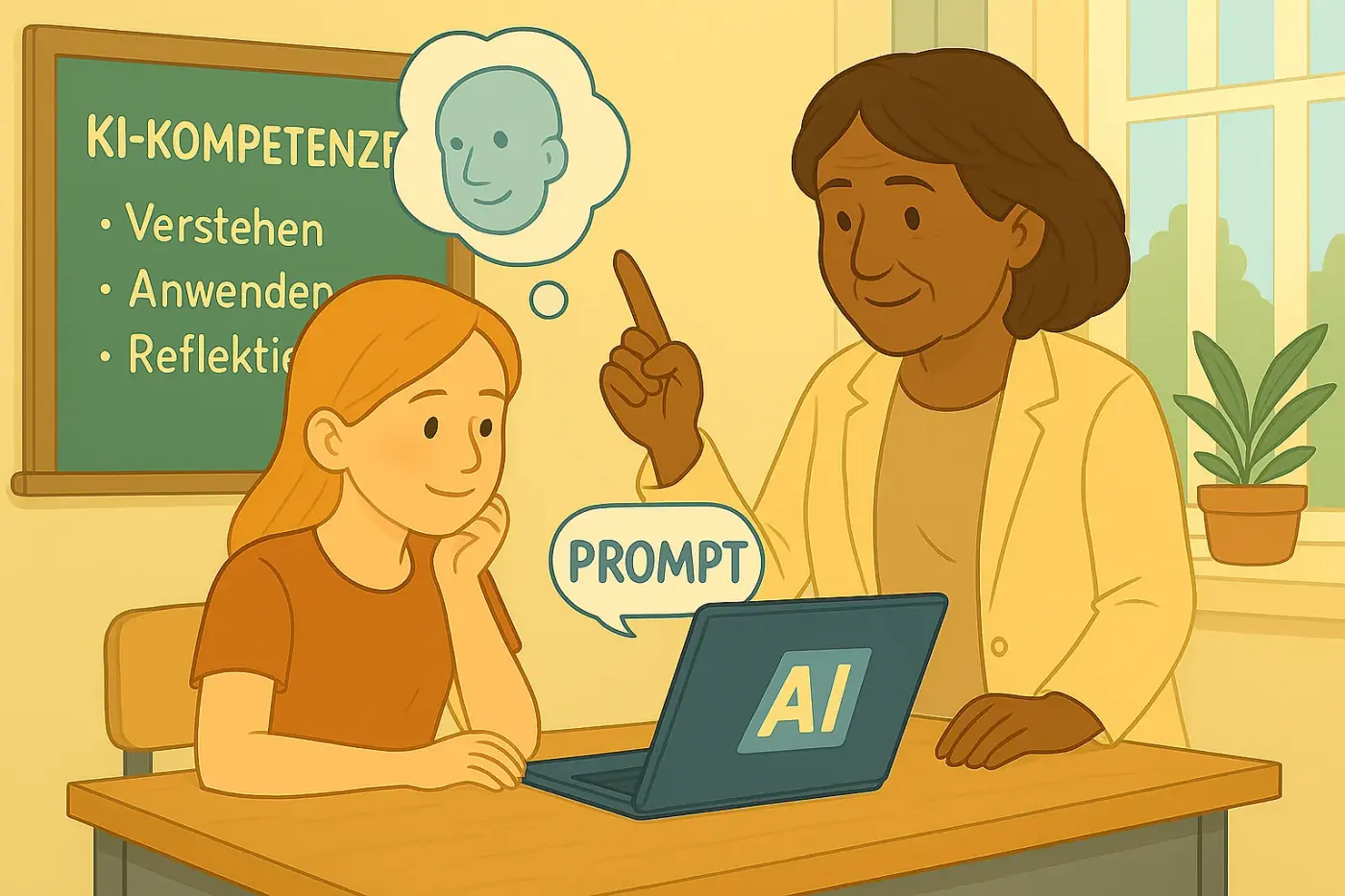
How learners can practice responsible use of AI and how teachers can support them
When I developed my prompting guide for students – which has since been published by IQES – I asked myself one simple but central question: How can learners use generative AI without becoming mentally detached from the process by which the results they generate with AI come into being?
In many classrooms I see that AI is already used as a matter of course, but often without a deep understanding of what is actually happening there and how the results come about. Students write prompts, vary them, copy results – but rarely do they reflect on the process. Equally, the quality of prompts is rarely sufficient and often does not meet the criteria for a good prompt. Students provide the AI with little or no context, formulate prompts without specificity, and barely define the target audience. The result is frequently an AI response that falls far short of what is actually possible. They see AI as a tool, but not as a "partner" in work processes. Yet it is precisely here that the greatest potential lies: AI literacy does not begin with the prompt, but with thinking about how AI tools can support learning processes and how language can create that access through targeted and effective prompts.
From prompt to disposition
At first I still believed that writing good prompts was primarily a technical skill, similar to mastering a programming language. In essence, this is still true: prompting does of course have a great deal to do with the ability to address the AI in linguistically precise terms. However, prompting is not purely a linguistic craft in which appropriate buzzwords are simply strung together; it is more a form of metacognitive steering. Because anyone who wants to prompt effectively must think about their own thinking – steering the creative process with AI from the intended end result backward.
In this sense, AI literacy is not an isolated digital skill, but a combination of language awareness, critical thinking, and process planning. Students must understand that every prompt contains a perspective – a framing that influences results. This matters all the more in times when AI not only generates texts, but also reproduces narratives, images, and dispositions.
Teachers play a central role here. They support learners not only technically, but help them to reflect on language, intention, and effect. AI literacy therefore always means thinking about one's own goals – about one's own motives and values in the learning process.
Learning in three dimensions
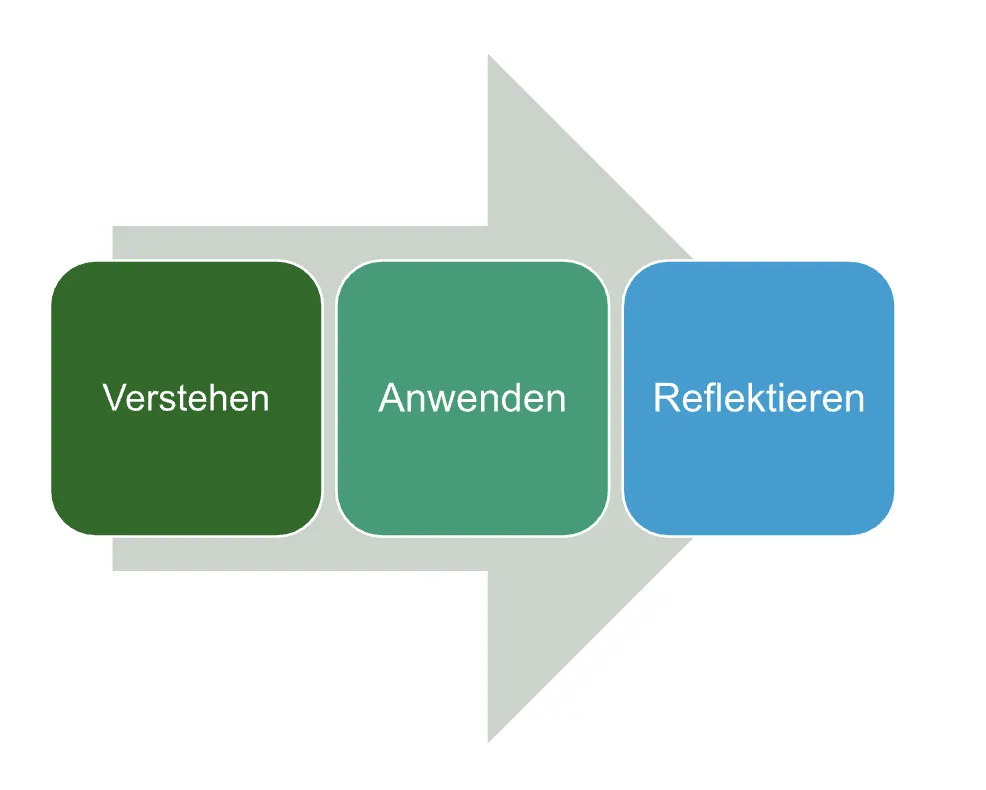
In my teaching, a structure has proved effective that draws closely on the competency model I developed for school leaders. It can be adapted for students when the aim is to understand AI as a learning resource:
-
Understanding: how does AI work, and what are its limits? What data does it use, what biases does it contain, what language shapes its responses?
-
Applying: how can prompts be formulated to deliver differentiated, precise, or creative results?
-
Reflecting: what responsibility do I bear for what I generate, use, or pass on? What disposition do I adopt?
These three levels form the framework for school-based learning with AI. They make clear: AI literacy does not emerge from use, but from becoming aware of it – from reflecting on one's own interaction with technology.
AI as a learning partner in the classroom
An example from practice: in a Year 9 class I asked students to write a short biography of a historical figure – first without, then with the support of AI. They then compared both texts, revised their own, and reflected on how far the AI had helped them to structure thoughts or condense language.
In this work, it became clear that AI did not serve as a shortcut, but as a feedback partner. Learners understand that the quality of a result depends on how they formulate their questions and what responsibility they take for selecting and evaluating responses. Prompting became a didactic instrument for making thinking visible – because the goal set at the outset could be directly compared with the result.
Similar processes can be observed in other subjects:
-
In German, AI becomes a writing coach that offers phrasings to be subsequently evaluated on linguistic grounds.
-
In ethics or politics, it can open up perspectives that are then critically examined.
-
In natural sciences, it helps to formulate hypotheses or structure experimental descriptions – always accompanied by reflection.
In this way, AI moves from being an alien element to a component of the learning process, taking on the role of co-creator of learning content and learning pathways. It is no longer merely a tool for quickly completing assigned tasks without effort and with notionally high quality, but serves instead as a "partner" in the creation process.
From prompt to learning strategy
At the core, something more fundamental is at stake. AI can make learning strategies visible and open to discussion. When students plan, test, and revise prompts, they automatically reflect on their goals and approaches – a central metacognitive competency.
In my current elective course on AI and prompting in Years 8 and 9, we examine the quality of AI responses together and analyze how they come about. The discussions resembled those one otherwise has about text structures or the logic of argumentation. Students began to articulate what makes a good response and why. This shifts the focus from the purely technical level to an actual consideration of results and an assessment of response quality.
These processes connect directly to Hattie's findings on self-regulation and a sense of efficacy. Learners who understand how they learn, learn more durably. AI can support this process if it is didactically framed – not as a substitute for thinking, not as a vehicle for skill-skipping and rapid shortcuts to completing redundant and AI-vulnerable task formats, but as a medium that can stimulate thinking.
Reflection questions as a bridge
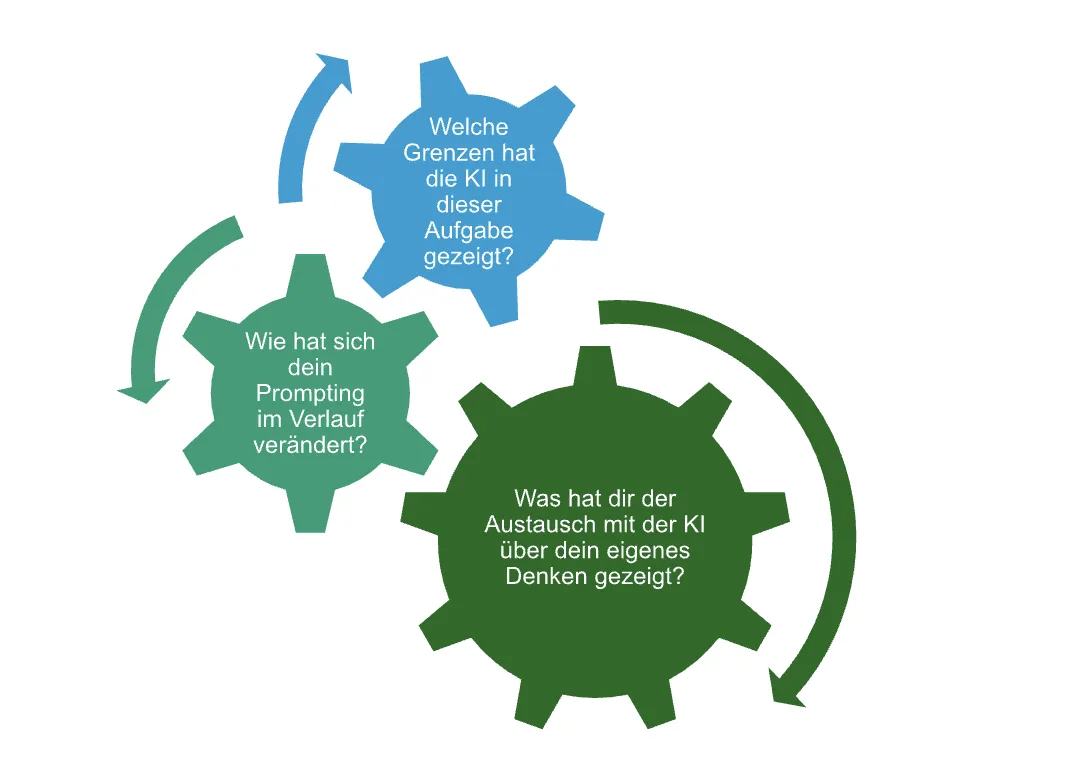
The prompting guide I developed includes targeted reflection questions at the end of each exercise. They are more than a methodological closing step; they are the heart of learning with AI. Questions such as:
-
"What did the exchange with AI reveal to you about your own thinking?"
-
"How did your prompting change over the course of the exercise?"
-
"What limits did AI show in this task?"
enable a shift from a product to a process perspective. Students experience that learning with AI is not a linear activity, but an iterative process – shaped by planning, application, review, and adjustment. This iterative approach and the evaluation of one's own processes is what students can and must learn in working with AI. We as teachers can support them by enabling access and creating space for these experiences.
Conclusion: AI literacy as educational competency
AI competencies are not an add-on that can be slotted in somewhere between media education and computer science. They now belong in general education in the curriculum, because they connect language, thinking, and responsibility.
When students learn to think with AI, they simultaneously learn to think about their own learning. And when teachers consciously accompany this process, AI does not become a threat to education, but its catalyst.
The path there begins not with technology, but with disposition – and with the willingness to turn prompts into conversations about thinking.
A complementary overview of different deployment contexts is available at Kipti and ChatGPT compared.
Related insights

AI in Schools 2026: Better Models, Better Education?
New AI models are growing more capable, but better education only emerges through clear frameworks, pedagogical responsibility, and the right deployment scenarios.
Björn Schriewer7 min read

How to Prompt AI in Multidisciplinary School Teams
A practical guide to using AI systems effectively in everyday school life through targeted prompting. Learn how clear communication with AI systems can deliver better results for documentation, lesson preparation, and support planning.
Björn Schriewer11 min read

How AI Can Support Everyday School Life
The integration of AI in the school environment is gaining in importance. Find out what support potential AI offers and what challenges need to be considered.
Sina Schriewer10 min read