
All-Day Schooling 2026: Opportunities for Municipalities
From 2026, a nationwide legal entitlement to extended-day care for primary school children comes into effect across Germany. What municipalities need to plan now, where the biggest challenges lie, and how Kipti supports teams in schools and youth welfare services.
Sina Schriewer3 min read
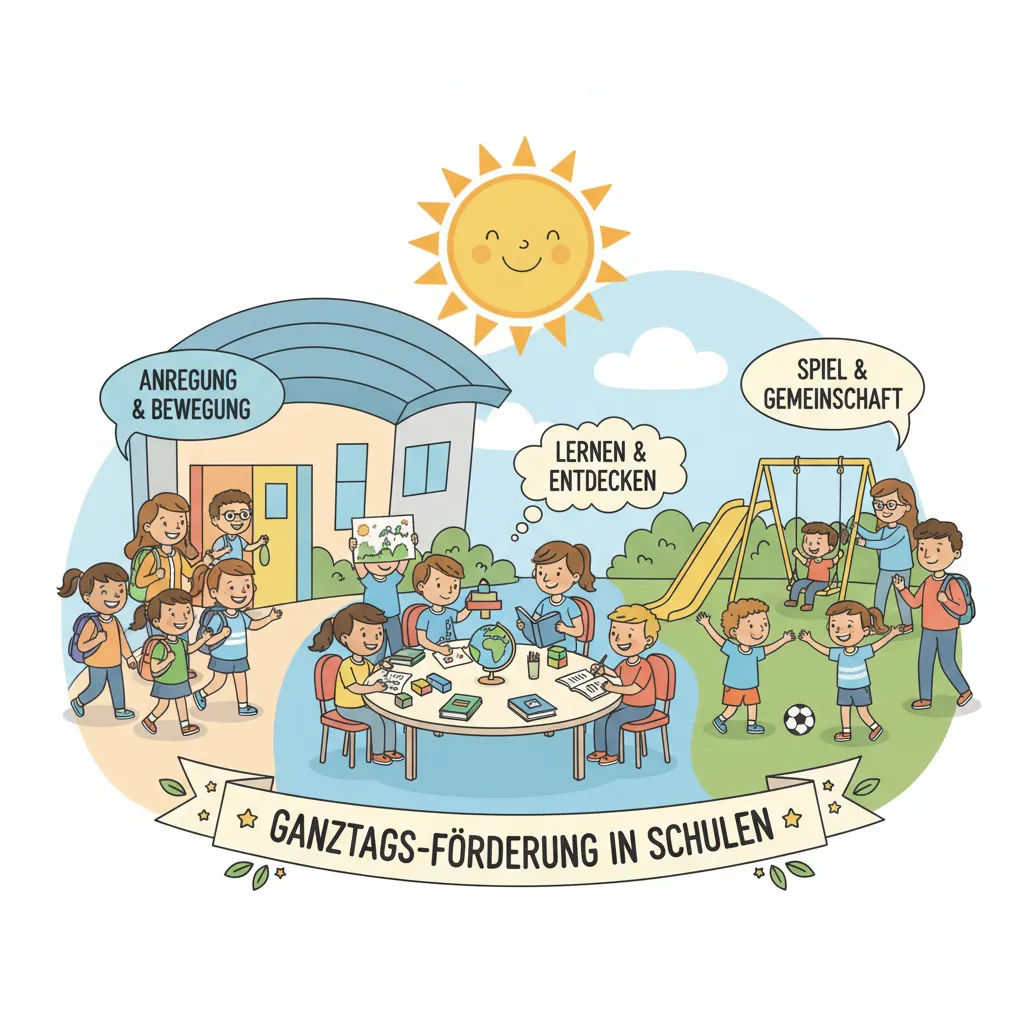
In Germany, extended-day provision is shared across the school and youth welfare systems and is implemented within federal-state frameworks.
From the 2026/27 school year, a nationwide legal entitlement to extended-day care for primary school children comes into force in Germany (§ 24 para. 4 SGB VIII, the German Social Code, Book VIII). All children enrolled from that point onward are entitled to care of up to eight hours per day on weekdays – until the transition to Year 5.
This entitlement can be fulfilled either by all-day primary schools (including open-model schools) or by extended-day programs offered, for example, by children's and youth welfare providers. This creates a new level of responsibility at the municipal level: youth welfare offices and school authorities must jointly ensure that sufficient places are available and that high-quality programs are established.
The role of municipalities
Implementation is the responsibility of the local youth welfare offices. They bear overall responsibility and planning responsibility for a needs-based infrastructure. The municipalities as school authorities are also called upon: they are responsible for buildings, facilities, cafeterias, care staff, and school development planning.
Particularly in rural areas, this entails complex coordination processes: district youth welfare offices must work with multiple municipalities, while in larger cities, responsibilities are often distributed across different departments within a single administration.
Different models
Depending on the federal state, different implementation pathways are envisaged:
- School model: extended-day provision takes place at the school, often as an open all-day school (OGS in German), but also as a part-structured or fully structured all-day school.
- Youth welfare model: care provided through after-school programs or extended-day offerings run by other providers, usually under the responsibility of youth welfare services.
- Mixed models: a combination of both approaches, depending on local needs and existing structures.
Municipalities have some latitude here, but must adhere to the state-level legal frameworks.
Key challenges
- Cooperation: extended-day care succeeds only when youth welfare services and schools work closely together. Formal agreements, regular exchange, and joint planning are decisive.
- Funding and staffing: state subsidies alone are often insufficient. Municipal co-financing, recruitment of qualified professionals, and clear quality standards are key levers.
- Different starting points: while in some states more than 80% of children already use extended-day programs, the rate in other regions is far lower. Municipal strategies determine how quickly expansion can be achieved.
Focus on quality
It is not only the number of places that matters: quality determines whether extended-day provision actually improves educational and participation opportunities. Important factors include:
- sufficient and qualified staff,
- strong collaboration between different professional groups and at the interface between instruction and extended-day provision,
- pedagogical concepts that integrate teaching and leisure time,
- suitable premises and facilities.
Digital solutions such as Kipti can support this: they facilitate collaboration within multidisciplinary teams, secure documentation and communication, and thus create more time for core educational work.
Conclusion
The legal entitlement to extended-day care is a milestone – and at the same time a major challenge. Municipalities bear the responsibility for shaping the expansion locally. Cooperation, quality assurance, and strategic planning are decisive if the entitlement is not only to be met formally, but actually to translate into better opportunities for children and families.
If your school or municipality is interested in exploring how Kipti can improve collaboration, simplify processes, and support quality assurance, we would be glad to hear from you.
Source:
- Sybille Stöbe-Blossey (2025): Ganztagsförderung für Kinder im Grundschulalter: Die Rolle der Kommune. In: Sozial Extra 3/2025, pp. 177–181.
Related insights

AI Monitor 2025: What Schools Actually Need Now
The Trendmonitor AI in Education 2025 shows: AI has arrived in everyday school life, but its potential is rarely used systematically. We summarize the key insights and show how Kipti supports schools.
Björn Schriewer4 min read

Guest Contribution: Communication Strengthens School Collaboration
Guest contribution by André Kolley: find out through three concrete examples how Kipti can practically solve the most common problems in school communication, documentation, and language accessibility – and thereby significantly ease everyday school life.
André Kolley6 min read
Class 0: A New Approach to School Readiness
More children are entering school with developmental delays. The nationwide Class 0 program provides targeted support to children with additional needs before they start school.
Sina Schriewer2 min read