Guest Contribution: Communication Strengthens School Collaboration
Guest contribution by André Kolley: find out through three concrete examples how Kipti can practically solve the most common problems in school communication, documentation, and language accessibility – and thereby significantly ease everyday school life.
André Kolley6 min read

Guest contribution by André Kolley
About the author: André Kolley has been an advisor at the Lower Saxony Ministry of Education since the end of 2022, where he is responsible for the all-day school sector, including its pedagogical, organizational, and statewide implementation. After holding various roles in the school sector, he served as a school subject inspector (with responsibility for all-day provision and non-teaching staff) at the Lower Saxony State School Authority and subsequently at the Regional State Office for School and Education in Hanover, accompanying diverse school development and participation processes. As a speaker, lecturer, BarCamp organizer, and workshop facilitator, he advocates beyond Lower Saxony's borders for a participatory all-day school that also makes meaningful use of digital tools in multidisciplinary teams.
Why Kipti Makes School Collaboration Easier
The growing number of educational professionals and external cooperation partners at all-day (primary) schools brings many benefits – but also new challenges. In this post, you will find out through three concrete examples how Kipti can practically solve the most common problems in school communication, documentation, and language accessibility, thereby significantly easing everyday school life.
In Germany, a legal entitlement to all-day care in primary school takes effect from August 1, 2026. Even ahead of this, many all-day (primary) schools already work with external partners, meaning that numerous additional parties are involved in everyday educational work. As the number of parties in the school system grows, GDPR-aligned communication between school staff and external cooperation partners becomes increasingly difficult, since many existing software solutions do not support direct communication. Given the currently difficult supply of teaching staff and the associated organizational adjustments throughout a school day or week, there is a lack of simple and fast software solutions for communicating with colleagues and guardians. External school partners also often find it difficult to reach the right people quickly and inform them comprehensively when needed. The following three typical examples illustrate why Kipti, with its simplified communication structure, can provide effective support and thus ease everyday school life:
-
Inadequate and unstructured information exchange Anyone working in a school will recognize this from experience: the school day begins, and due to last-minute absences, the timetable program has to be hurriedly reorganized with cover arrangements and cancellations. While the display of substitute plans usually works smoothly, the direct, simple, and fast communication of information – especially in all-day schools – is often a challenge. A central problem is that the necessary information exchange between teachers, educational staff, school social workers, guardians, and external professionals is barely supported by the existing timetabling programs. There is a lack of fast, secure, GDPR-aligned, and practical solutions, which makes collaboration more difficult and creates additional organizational effort. Why Kipti helps here: Kipti provides a platform that enables smooth and secure information flow, facilitates multidisciplinary collaboration, and supports comprehensive GDPR-aligned data handling. Cooperation among all parties is substantially simplified through a central repository and direct communication options.
-
High time expenditure due to analog and inconsistent documentation Many school leaders and teachers still use a mixture of analog methods (e.g., paper) and various digital tools for documentation and organizing notes. Particularly with the parallel use of different digital solutions, it is increasingly difficult to pass on available information in a consolidated form, store it permanently, and retrieve it quickly at any time. This leads to significant time loss, inconsistent information, and makes efficient documentation more difficult. Individual student support was traditionally managed mainly from the teacher's perspective, meaning that important observations from other educational professionals – especially in the afternoon area – were often only passed on briefly between lessons or on small scraps of paper. Kipti now makes it possible, for example, for information from extended-day provision to be forwarded directly by educational staff to the class teacher or other responsible persons. In this way, the social skills and abilities of students can be comprehensively recorded and documented, independent of the academic grading pressure of the morning, and later given appropriate consideration. Educational staff from external cooperation partners are also given the opportunity to share relevant observations in a protected environment – observations that until now mostly went unnoticed to the detriment of students. This applies in particular to indicators under § 8a SGB VIII (the German Child and Youth Services Act), which can be observed throughout the day, dated, and documented for future consultation. Why Kipti helps here: Kipti enables clear, centralized, and device-independent documentation. Intelligent support functions such as speech-to-text and automatic AI-generated summaries significantly reduce the documentation burden and ensure that information is available quickly, reliably, and consistently. With Kipti, important information about students can be captured, shared, and centrally managed more efficiently than before – which is particularly helpful when staff absences occur at short notice.
-
Lack of accessible and multilingual communication in and around the school system Communication between guardians, the school, and cooperation partners is frequently hampered by language barriers and a lack of accessible materials. Creating multilingual or plain-language communication materials takes a great deal of time and is usually very difficult to implement in everyday school life. Compounded by the employment of foreign professionals – for example, from Ukraine, who had previously worked in education – multilingualism is not only common among students, but increasingly also within the educational staff and is welcomed. This diversity reinforces existing challenges and frequently leads to the use of various non-standardized software solutions. Since multilingualism will continue to increase in the future, it is necessary to provide a practical and secure communication solution promptly. This also concerns the school's external communication, especially with guardians, and should not place additional burdens on educational professionals by requiring them to independently research suitable software solutions. Why Kipti helps here: Kipti offers automated translations into various languages and also enables the provision of content in plain language. Particularly in the current situation, educational staff with limited German-language skills can be easily integrated and kept informed. Overall, Kipti promotes improved and inclusive communication with all parties, which in particular strengthens the flow of information to guardians.
When communication pathways are simplified, documentation burdens reduced, and language barriers overcome, pedagogical and organizational space opens up for everyone involved. These freed-up resources allow staff to focus more intensively on their core tasks: the individual accompaniment of children and young people on their path of growing up, targeted support for their learning processes, and the positive development of their personalities. Ultimately, a tool like Kipti – developed in partnership with schools – can not only ease everyday working life, but also sustainably improve the quality of holistic care and education in schools.
I look forward to continuing to follow Kipti's development with great interest.
Want to Try and Help Shape Kipti?
We look forward to hearing from you! Feel free to send us an email at info@kipti.app
Related insights
AI Monitor 2025: What Schools Actually Need Now
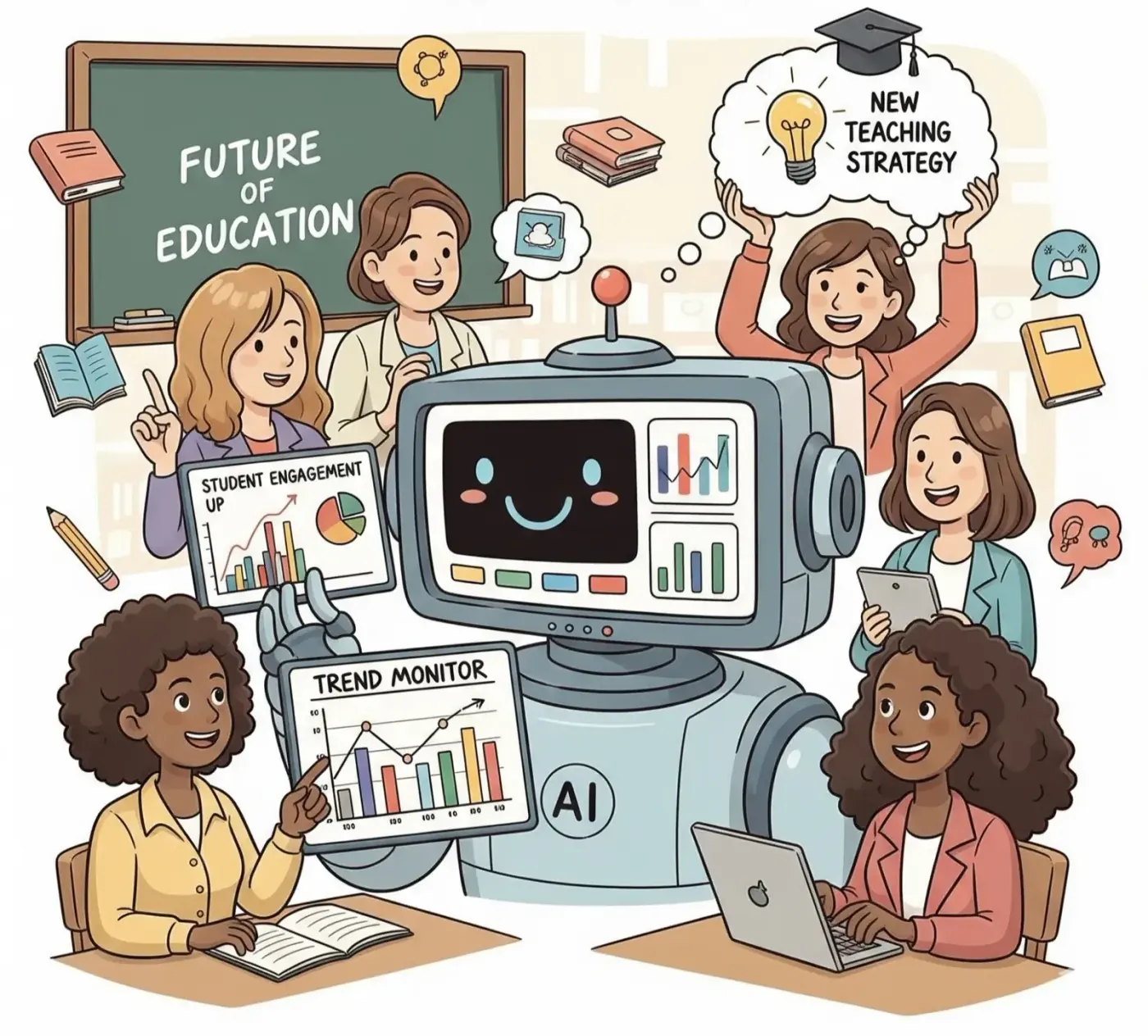
The Trendmonitor AI in Education 2025 shows: AI has arrived in everyday school life, but its potential is rarely used systematically. We summarize the key insights and show how Kipti supports schools.
Björn Schriewer4 min read

Strong Education Networks Improve Education Together
Guest contribution by Georg Babing (edusiia): why exchange and strong networks are so important for education professionals – and how edusiia as a digital network helps.
Georg Babing3 min read

Violence Prevention in Schools: Acting Early
Violence prevention starts long before an incident occurs. Schools need clear responsibilities, reliable communication channels, and jointly owned protection concepts.
Sina Schriewer7 min read