
Early Identification: Warning Signs and Digital Support
Assessment begins in the classroom. This overview looks at warning signs of dyslexia, dyscalculia, and ADHD—and how digital tools can support teachers with observation.
Björn Schriewer5 min read

During my training as a special needs care professional, I learned early on that assessment does not begin only in a physician's or psychologist's office. It begins wherever a child spends everyday life—and that is often the classroom. Today, as a computer scientist, I also look at the technology that can reduce the burden: How can we help teachers integrate complex observation forms and screenings into a full school day?
In Germany, teachers often provide the day-to-day classroom observations that inform support planning and referrals to qualified specialists.
Teachers play a key role in recognizing patterns that may indicate a need for support or behavioral concerns. Early identification makes it possible to initiate support before problems become entrenched. This article provides an overview of research-based methods for early identification and explains how we at Kipti are working to make the documentation process easier.
1. Dyslexia: More than slow reading
Not every difficulty with reading is dyslexia. Research does, however, identify clear indicators that often become visible early.
- Warning signs: One important sign in the first years of school is uncertainty when naming letters or an inability to blend sounds while reading ("C-A-T" instead of "cat"). Later signs include frequent guessing at words or a high error rate despite practice.
- Assessment tools: Germany's S3 guideline for diagnosing reading and spelling disorders recommends evidence-based procedures. These include established screenings such as the Bielefelder Screening (BISC) for preschool children and the Salzburger Lese-Rechtschreib-Test (SLRT-II) for assessing learning progress.
- Digital developments: Digital whole-class screenings now make it possible to assess an entire class efficiently. One current example is the Dysmate test system, which is available for elementary schools and, since 2025, as Dysmate-Y for lower secondary schools. Studies indicate that tools of this kind can help identify previously hidden difficulties reliably, including among older students.
2. Dyscalculia: When Quantity Sense Is Missing
With dyscalculia, foundational concepts may be missing and cannot be compensated for simply by practicing calculation procedures.
- Warning signs: A strong indicator in the first two years of school is continued reliance on finger counting or an inability to recognize quantity relationships spontaneously, such as whether five is more than three. Mechanical counting without understanding the decimal system is another typical warning sign.
- Assessment tools: The Fragebogen zur Erfassung mathematischer Fertigkeiten (FERMAT) was developed for teachers. Studies by TU Dortmund show that this tool can identify children at risk within a class with a reported sensitivity of approximately 58–70 percent.
3. Behavioral concerns: ADHD and emotional development
Distinguishing lively behavior from a diagnosis such as ADHD can be difficult in the classroom. Research-based guidelines emphasize the need for a multimodal assessment that includes several perspectives, including those of parents, school staff, and the child.
- ADHD indicators: A key distinction is whether symptoms such as inattention, impulsivity, and motor restlessness persist over time and across situations. Standardized teacher questionnaires, such as those in the DISYPS system, can help structure observations that would otherwise remain subjective.
- Social and emotional concerns: Screening questionnaires such as the Strengths and Difficulties Questionnaire (SDQ) are well established in this area. The internationally recognized SDQ, which is used in studies including the Deutsches Schulbarometer, assesses emotional difficulties as well as prosocial behavior.
- Autism spectrum: Subtle signs may include difficulties with social interaction, limited eye contact, or highly repetitive interests. Screening questionnaires such as the Fragebogen zur sozialen Kommunikation (FSK) can give teachers and parents an initial indication that a specialist assessment may be appropriate.
4. The everyday challenge: Systematic observation
Research is clear that a sound assessment requires more than a snapshot. It requires systematic behavioral observation over several weeks. Only then is it possible to distinguish a bad day from a genuine developmental pattern.
In practice, the obstacle is often not a lack of teacher knowledge, but a lack of time for documentation. Loose notes and records written from memory are prone to errors during a hectic school day. Concerns are often documented only after a situation has already escalated.
How Kipti supports the process
At Kipti, our team brings together educational experience from teachers and school leaders with technical expertise. We developed the app for exactly this intersection.
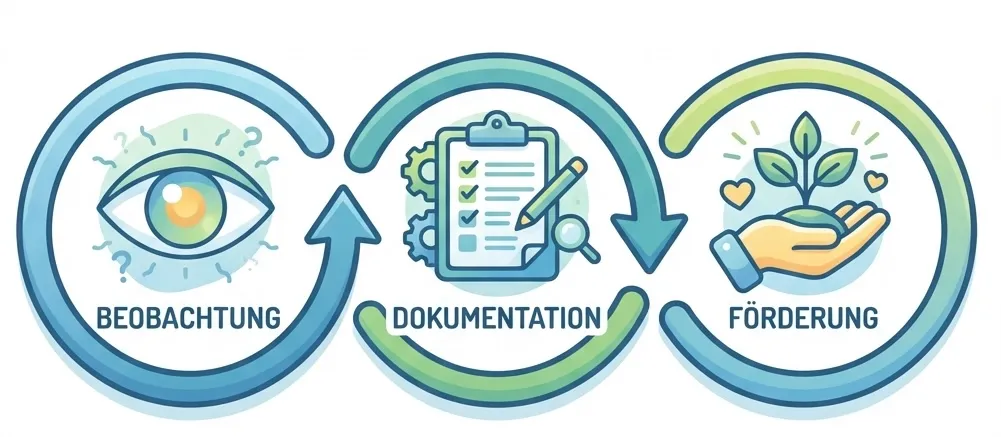
Kipti is not a diagnostic tool and does not replace qualified specialists. It is a tool for building the necessary documented foundation:
- Recognize patterns: Kipti supports continuous documentation of classroom observations. Instead of scattered notes, it creates a record that makes changes over time visible.
- Support informed collaboration: When multidisciplinary teams such as special education teachers and school psychologists become involved—an approach currently supported in Germany by the Startchancen-Programm—Kipti provides a documented basis for those conversations.
- Reduce administrative burden: The goal is to keep administrative work manageable so that more time remains for education and individual support.
Early identification requires a trained eye and persistence. With appropriate research-based methods and efficient documentation, schools can help students receive the support they need.
References
This article draws on current guidelines and research on school-based assessment:
- Reading and spelling guideline: AWMF S3-Leitlinie „Diagnostik und Behandlung der Lese-/Rechtschreibstörung“ (registration number 028-044).
- ADHD assessment: Döpfner et al.: Diagnostik-System für psychische Störungen (DISYPS-III) & ADHS-Diagnostikum für Kinder und Jugendliche (ADHS-KJ).
- Dyscalculia screening: Kuhn, J.-T. et al.: Entwicklung eines Lehrkräftefragebogens zur Früherkennung von Rechenstörungen (FERMAT), TU Dortmund.
- Digital assessment: Larsen, L. et al.: Dysmate-Y – Digitales Klassenscreening (2025) & Dysmate-C.
- Social-emotional development: Goodman, R.: Strengths and Difficulties Questionnaire (SDQ); and findings from the Deutsches Schulbarometer.
- Autism screening: Bölte, S. et al.: Fragebogen zur Sozialen Kommunikation (FSK).
Related insights

Data-Informed School Development: Who, If Not School Leaders?
Data can make school development effective — when school leaders treat it as a leadership instrument and get their teams to act together.
Norman Graf6 min read

Schools and Youth Centers Against Educational Inequality
Schools and open child and youth services can address educational inequality together by connecting places to learn, trusted relationships, and practical support.
Sina Schriewer4 min read

School Barometer 2026: Youth Mental Health Concerns Everyone
The 2026 School Barometer reports alarming levels of distress among young people. Schools need protective factors, participation, and health literacy.
Sina Schriewer5 min read