
Schools and Youth Centers Against Educational Inequality
Schools and open child and youth services can address educational inequality together by connecting places to learn, trusted relationships, and practical support.
Sina Schriewer4 min read

It is a sobering reality in Germany's education system that academic success still depends heavily on social background. Education sociologist Aladin El-Mafaalani warns that schools are operating in a structural state of crisis and that inequality in outcomes is worsening across all levels of schooling.
When families lack the necessary financial resources, time, or language skills, the path to a higher qualification can become a steep climb. The current school system still depends heavily on support from families. Yet some young people achieve what researchers call “unlikely educational mobility,” often with help from Germany's open child and youth services.
In Germany, open child and youth work (OKJA) is a voluntary, locally organized part of youth services that operates alongside formal schools.
Schools, Youth Work, and Places to Belong
At first glance, schools and youth centers have little in common. Schools are places of achievement, curricula, and grades. Open youth work is built on voluntary participation, openness, and young people's ability to shape their own free time.
Yet that contrast holds considerable potential for reducing educational inequality. El-Mafaalani argues that schools need to become genuine places to live for children. Teachers and social educators should collaborate as equals in multidisciplinary teams. This not only reduces pressure on teachers, but especially supports disadvantaged children for whom school may be the only stimulating learning environment available.
A protective alternative to performance pressure
For many young people from socially disadvantaged backgrounds, the formal school system can feel like a world disconnected from their own reality. Researchers describe this as a lack of fit. Students may feel that teachers do not see them as individuals, but measure them only by performance.
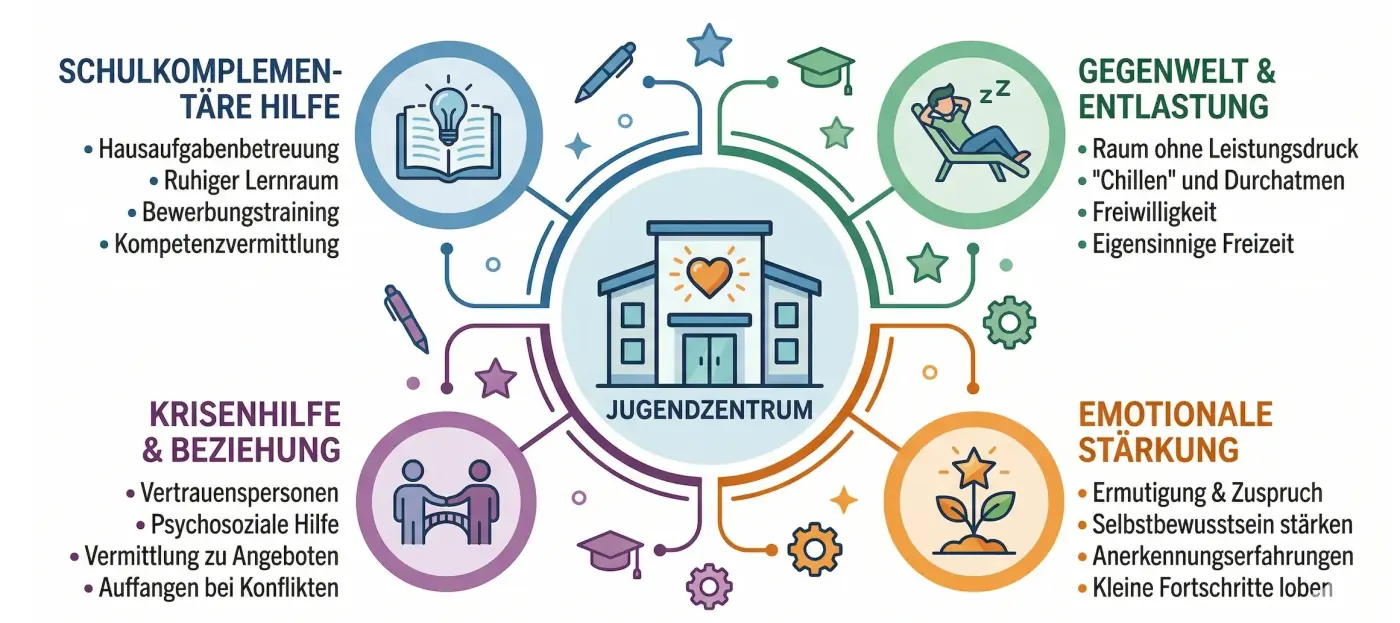
Open youth work provides an important alternative experience. Youth centers offer a space without compulsion or a predetermined purpose—a place to relax and breathe. This psychosocial relief from school and family stress can act as a crucial buffer, making it possible for young people to face school demands again the next day.
Practical help where families reach their limits
Although it is not the central educational mission of youth work, these organizations provide concrete support that complements school. When parents cannot help with homework because of language barriers, or when a home lacks a quiet place to study, a youth center may step in.
Open youth work can offer resources that support academic success but may be missing at home:
- Homework support
- Job-application training
- A quiet desk for studying
A Youth Center on School Grounds
The “Café Ziegler” pilot project in Mülheim an der Ruhr shows that these two worlds can also merge successfully in one physical location. An open youth center was established directly at a Gymnasium, a German academically oriented secondary school. In the afternoons and evenings, it serves not only the school's own students, but young people from the surrounding community.
Models like this bring the methods of open youth work directly to the school site, open the institution to its neighborhood, and create new shared educational opportunities.
A source of confidence
Encouragement is an often underestimated factor in academic achievement. People who have advanced educationally despite substantial barriers repeatedly describe how important encouragement from youth-center professionals was to them. A middling grade may cause disappointment at home, or a good grade may go unnoticed. Staff in open youth work also recognize smaller steps. They signal that young people are good enough as they are. These experiences of recognition strengthen confidence and help sustain motivation through setbacks.
More than recreation
When young people experience a crisis, whether bullying at school or serious conflict at home, open-youth-work staff provide support. They serve as:
- Trusted contacts
- Psychosocial anchors
- Guides to further support services
Conclusion: Open child and youth work is an essential complement to school. By addressing emotional, spatial, and practical gaps that the formal school system often leaves open for disadvantaged young people, it becomes an important contributor to reducing educational inequality.
References
- Interview | Prof. Dr. Aladin El-Mafaalani: Schulen im Krisenmodus – mehr als eine Momentaufnahme. (Veröffentlicht auf excitingedu). Thematisiert die notwendige Entlastung von Lehrkräften, die starke Abhängigkeit des Bildungserfolgs von der Familie und die Forderung nach der „Schule als Lebensort” mit multiprofessionellen Teams.
- Forschungsverbund DJI/TU Dortmund: Offene Jugendarbeit am Ort Schule – Verbesserte Bildungsgelegenheiten für Heranwachsende? Wissenschaftliche Untersuchung am Beispiel des Modellprojekts „Café Ziegler” in Mülheim an der Ruhr, das die Ansätze der OKJA an den Lernort Schule bringt.
- Scharf, J., Damm, K., Kuger, S. & Maaz, K. (Hrsg.) (2026): Bildungsbarrieren identifizieren – Bildungschancen entwickeln. Potenziale verschiedener Lernumwelten beim Abbau von Ungleichheit. Waxmann Verlag.
- Kapitel 5 (Grendel, T., May, M. & Franz, A.): Bildungsbarrieren im Spannungsfeld von Angebot und Aneignung. (Fokus auf das Konzept der „Nicht-Passung” und die OKJA als Raum ohne Verzweckung).
- Kapitel 7 (Doll, D., Adjei Otuo, S. A., Gamper, M. & Scherr, A.): Die Bedeutung von familiären Beziehungen und der Offenen Kinder- und Jugendarbeit für unwahrscheinliche Bildungskarrieren. (Fokus auf schulpraktische Hilfen, die Rolle von Ermutigung und die Entlastungsfunktion bei Krisen).
Related insights

School Barometer 2026: Youth Mental Health Concerns Everyone
The 2026 School Barometer reports alarming levels of distress among young people. Schools need protective factors, participation, and health literacy.
Sina Schriewer5 min read
Educational Opportunity in Germany Still Depends on Background
Social background still determines children's educational paths in Germany. A study by the Leibniz Institute for Educational Trajectories shows how educational inequality develops — and identifies three levers we need to move now.
Sina Schriewer4 min read
Growing diversity in schools: Challenges and practical responses
Diversity in schools brings educational variety, but also places substantial demands on teachers. Recent School Barometer data and a study by Susanne Enssen point to systemic responses.
Sina Schriewer3 min read