
Rethinking Assignments – How AI Is Changing Assessment Culture
A new balance between knowledge, thinking, and creation. Norman Graf shows how AI forces us to reframe learning processes and turn assignments from a test of recall into a space for thinking.
Norman Graf6 min read
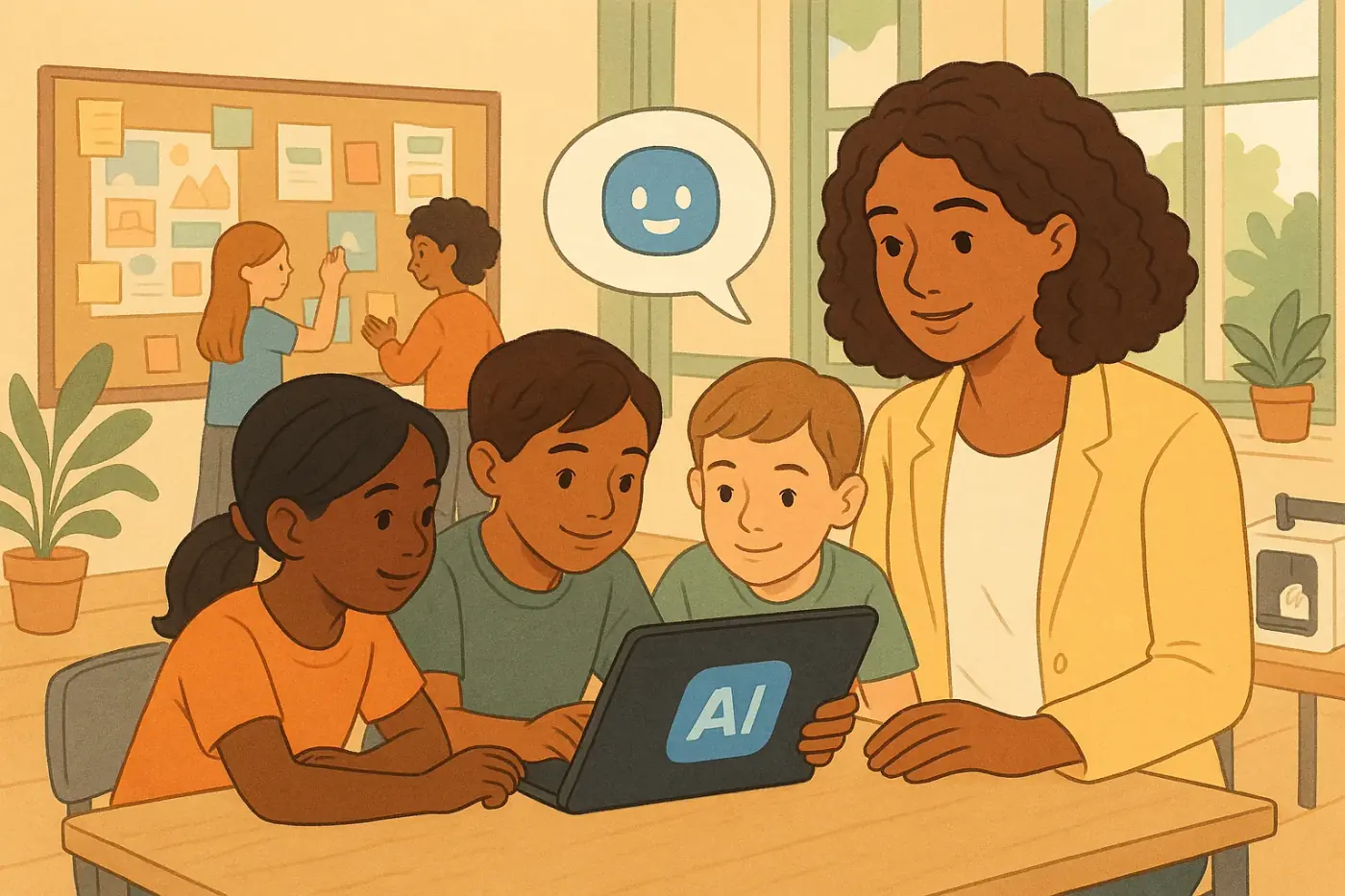
A new balance between knowledge, thinking, and creation
Over the past months I have had countless conversations with colleagues about the use of AI in teaching. Almost invariably, a question comes up at some point in one form or another: "How do we handle assignments that ChatGPT can solve in seconds?" or "How can I allow AI when it calls my entire approach into question?"
This question is entirely justified, understandable, and gets to the heart of the discussion about AI and assignment formats, because it strikes at the very center of school work. It touches not only technical or organizational aspects, but the core of many colleagues' current understanding of learning. It forces us to think about what a good assignment should actually achieve today. And it challenges us to have the courage to change assignments in such a way that, despite and together with AI, they do not become superfluous, but remain meaningful, effective, and purposeful.
Assignments are more than tests of recall
In everyday school practice, assignments often serve as a means of checking knowledge or practicing defined procedures. They are the backbone of most teaching, yet they are rarely themselves the subject of pedagogical reflection. This is mainly because students are still rarely involved in the design or reflection of school assignments and content.
The introduction of generative AI now calls this taken-for-granted approach into question. We are suddenly confronted with the fact that many classic assignment formats – summaries, factsheets, interpretations, and so on – have become technically solvable. Not because they are poor tasks, but because they target a different learning logic: the pure reproduction of what has been learned, without requiring any reflective engagement beyond the task itself.
It would, however, be hasty to discard these tasks entirely. They train foundational skills such as linguistic precision, structuring, and understanding of worked content – skills that are indispensable for any further thinking. The goal is not to replace them, but to place them in a new didactic context. Away from pure reproduction, toward reflection, evaluation, and creative work. Without "skill skipping," but with a changed focus.
From knowledge recall to a space for thinking
I observe that AI forces us to reframe learning processes. Previously, the central question was: What do students know? Today it must read: What do they do with the knowledge they have or that is available to them with the help of AI?
This shift changes the meaning of the assignment itself. It moves from a test of recall to a thinking space – a place where learners engage with content, form hypotheses, compare, discard, and recombine.
A new assessment culture therefore places not control at the forefront, but activation. It aims to enable learners to engage with the possibilities and limits of artificial intelligence, while simultaneously deepening their subject-matter and metacognitive competencies by using AI as a learning partner and co-constructor.
Practical examples of different assignment formats
Reflection tasks: AI as an occasion for thinking
An example from my practice: in a Year 8 history class I asked students to use AI to sketch what significance the Industrial Revolution had for the development of European states. They then had to evaluate the AI's response.
This initially produced astonishment: the AI wrote fluently, clearly, and for the most part coherently. It mentioned the availability of coal and iron, technical innovations, and the role of heavy industry in the development of European states. But in the next step, students noticed that it barely touched on critical aspects – such as child labor, the living conditions of workers, or the profound social changes that accompanied the industrialization process.
This was precisely where genuine learning could begin. Students supplemented, questioned, sought evidence, and connected technical developments with important social consequences.
This form of task shifts the focus – away from the pure production of a text toward engagement with perspectives, quality, and context. The AI provides the occasion and the students do the thinking.
Creative tasks: AI as partner, not adversary
Particularly interesting are tasks in which AI becomes a creative sparring partner. They open learning spaces in which language, imagination, and reflection are intertwined. In a German class, students began their own short stories and had the AI formulate several alternative endings. The task was not to simply adopt one of the AI's versions, but to compare them critically. Which version feels emotionally more coherent? Which is linguistically more precise, which is more logically structured, which do I prefer? And above all: which ending meets the criteria I named?
In the discussions it became clear that students were exchanging views on text quality and AI results, searching for and evaluating previously learned criteria in the texts. They recognized that a convincing narrative is shaped not only by plot, but by rhythm, perspective, and atmosphere. AI became a mirror for their own decisions: where does creativity end, where does routine begin? When does a text feel "rounded," when does it feel artificial?
This form of task simultaneously strengthens aesthetic judgment, linguistic awareness, and a sense of self-efficacy. Learners discover that AI can supply ideas, but the quality of the result depends on the decisions they make – and only through meaningful and effective instructions does quality emerge.
In this way, AI becomes not a shortcut, but an occasion to reflect on language, effect, and intention. It helps to make one's own writing more deliberate and at the same time opens up a view of the creative process as something shapeable and reflective.
Teachers Move From Task-Setters to Learning Architects
A new assessment culture requires a changed stance from teachers. We need to think less as task-setters and more as learning architects.
This means not seeing assignments in isolation, but as part of a didactic system:
- What competencies are at the center?
- What strategies or tools can deepen learning processes?
- How can reflection be made visible?
- What role can AI play – and what role can it not play?
In this role, we design learning environments in which students take on responsibility and can meaningfully integrate AI as a resource.
A culture of trust and openness
In my work I repeatedly experience that an assessment culture can only grow where there is room for experimentation and trust. Our motto when starting out in all areas of development has therefore been for years: "Anyone can, no one has to."
This phrase may sound banal, but it carries a decisive idea: innovation requires voluntariness. Teachers must have the opportunity to test new assignment formats, discard them, revise them – without fear of failure or justification. Of course, this phase of experimentation is followed by consolidation and accountability, but only after a certain time has passed.
This culture of openness is, in my view, the prerequisite for teaching to develop effectively and innovatively. AI is not the goal here, but the occasion for shared learning processes – including at the level of teachers themselves.
Conclusion: Assessment Culture Mirrors Learning Culture
AI makes it clear that many of our assignments no longer fit the conditions of today's learning. But it also shows how great the potential is when we change them.
A contemporary assessment culture connects subject-matter learning, thinking, and self-direction. It holds on to the acquisition of foundational skills without treating them as absolutes. And it uses AI as a mirror to take a fresh look at the quality of assignments, learning processes, and dispositions.
Related insights

AI Leadership Requires a New Digital Approach
Many school leaders sense that AI is changing schools, but few feel prepared. This article presents AI leadership as a mindset for navigating stability and change and introduces a practical AI competency model for school leadership.
Norman Graf5 min read

Schools under pressure: Studies on workload and AI
Three studies explore the pressures schools face and how collaboration, clear processes, and AI may help reduce their workload.
Sina Schriewer6 min read

Needs compass: Finding solutions for your school
Clarify your needs before choosing a tool. Four questions help your school team identify which solution fits your everyday work.
Sina Schriewer5 min read