
Schools under pressure: Studies on workload and AI
Three studies explore the pressures schools face and how collaboration, clear processes, and AI may help reduce their workload.
Sina Schriewer6 min read

Documenting, organizing, processing applications, preparing information, and coordinating agreements: Everyday school life involves many tasks that make teaching and educational work possible. They also take time and attention. As expectations around student support, collaboration, and school development grow, reducing the workload becomes an increasingly urgent concern.
The Cornelsen School Leadership Study, the German School Barometer, and the AI in Education Trend Monitor examine this situation from different perspectives. All three focus on education in Germany. Read together, they point to a connection: Schools need more space for demanding educational work. AI may help, provided its use also takes account of the organizational conditions that make this work possible.
The pressure affects the whole school
In the Cornelsen School Leadership Study 2026, 94 percent of surveyed leaders at general education schools report growing responsibilities without sufficient relief. Eighty-seven percent lack enough time for leadership, development, and shaping their schools. Among participating schools in Germany's Startchancen program, which supports schools serving disadvantaged communities, 82 percent identify documentation and evidence requirements as an obstacle to implementing the program. Good initiatives also need working conditions that allow them to succeed. (Cornelsen School Leadership Study 2026, summary, pp. 4, 7, and 10)
The German School Barometer's 2026 teacher survey adds the staff perspective. Forty-six percent of respondents name student behavior as one of their greatest professional challenges, up from 35 percent in 2024. Another 34 percent mention the diversity of the student population. These demands extend well beyond teaching subject knowledge. (German School Barometer, teacher survey 2026, pp. 16–17)
The two studies cover different groups and research questions. Their percentages therefore cannot be compared directly. Their findings do complement each other: While school leaders describe limited room to shape their schools, teachers experience how demanding it has become to support a wide range of learning and developmental needs every day.
This reveals an important connection between organization and education. The more attention individual support, social conflicts, and collaboration with families require, the more important it becomes to keep avoidable administrative and coordination work to a minimum.
Reducing workload also depends on collaboration
In the Cornelsen study, 69 percent of school leaders see multidisciplinary teams as a central way to improve learning outcomes. Ninety percent want a better distribution of responsibilities to ease the leadership workload. (Cornelsen School Leadership Study 2026, summary, pp. 6 and 14)
The School Barometer also points to the importance of working together: In the study, a collaborative school culture and support from school social workers are associated with lower perceived strain. (German School Barometer, teacher survey 2026, pp. 63–65)
Collaboration needs reliable structures. Responsibilities must be clear, information accessible, and agreements traceable. Without these foundations, a larger team can also require more coordination. Reducing workload therefore means both expanding professional support and organizing shared work well.
AI use centers on lesson preparation
AI is already being used, particularly for lesson preparation. According to the School Barometer 2026, a quarter of teachers use AI daily or several times a week. In the previous edition, that figure was eleven percent. AI is becoming a regular work tool for a growing share of teachers. (German School Barometer, teacher survey 2026, p. 37, fig. 3.2)
However, its uses are unevenly distributed. Among teachers who use AI at least occasionally, including those who use it only rarely, 64 percent use it to create classroom assignments and 58 percent for lesson planning. Thirty-three percent use it for communication, and 18 percent for administrative tasks. These figures show a clear emphasis on preparing lessons. (German School Barometer, teacher survey 2026, p. 38, fig. 3.3; reference group: 1,389 teachers who use AI at least rarely)
That is understandable: Drafting an assignment or adapting a resource offers a manageable starting point. Teachers can assess its usefulness directly in their own lessons. Given the pressures described in both school studies, though, it is worth considering a wider range of support.
AI may also support school processes
The AI Trend Monitor broadens the perspective to school processes. The AI in Education Trend Monitor 2026, published by Deutsche Telekom Stiftung, confirms the high potential experts see in lesson preparation and resource creation. It also describes AI for school management and administration as a field with limited uptake so far. Nevertheless, the experts surveyed consider support for planning and management particularly useful. Complex processes and decentralized data storage have made adoption more difficult. (AI Trend Monitor 2026, pp. 8–9 and 34–37)
This connects the findings of all three studies: A substantial need to reduce workload meets AI use that remains heavily focused on individual teaching-related tasks. It raises the question of which other recurring tasks could benefit from support.
Possible examples include preparing staff meetings, parent conversations, or parent-teacher conferences. AI can bring existing information together for an agenda, structure discussion notes, or assist with organizational planning. Documented observations can also provide a basis for initial drafts of student support reports and learning progress reports, the narrative progress documents used in parts of the German school system. Professionals then review and supplement those drafts.
For school development and organization, AI can also serve as a thinking partner: breaking a project into steps, weighing different approaches, or identifying open questions in a proposal. An internal school chatbot could help staff find rules, responsibilities, and agreements in approved documents more quickly. Such applications support tasks that regularly take time in everyday school life and often involve several people.
Agentic systems connect multiple steps
Agentic systems offer another perspective. In response to an assignment, they can plan and connect several steps. According to the AI Trend Monitor, few ready-made AI agents for schools were available by spring 2026; they are often configured individually. The experts surveyed nevertheless expect their importance to grow substantially over the next five years. (AI Trend Monitor 2026, pp. 20 and 30–32)
For recurring organizational tasks, this might mean assembling relevant documents and using them to prepare a staff meeting with an agenda and open questions. This offers a potential direction for supporting connected workflows.
These are possible starting points, not promises of specific time savings derived from the studies. Whether an application actually reduces workload depends on how well it fits a particular process and how much effort input, review, and follow-up require.
Implementation must itself be manageable
A tool can create additional work if information is entered twice, responsibilities remain unclear, or results require extensive checking. Before adopting it, schools should review their existing processes: Which work is necessary? What can be simplified? Where can technical support take on a clearly defined part?
This also requires suitable professional development and reliable support. In the School Barometer, 52 percent of teachers identify a personal need for training in AI use. Growing uptake does not yet mean consistent confidence in using it. (German School Barometer, teacher survey 2026, pp. 13 and 69)
Clear access rights and results that can be checked are particularly important when working with school information. The AI Trend Monitor emphasizes human responsibility and recommends using AI in a supporting role. (AI Trend Monitor 2026, pp. 58–60)
Taken together, the studies suggest treating workload reduction as a shared organizational and educational responsibility. It requires sufficient staffing, good collaboration, clear processes, and suitable digital support. AI can contribute within this framework. Its usefulness should be measured by whether it simplifies work and creates the space schools need for individual support, relationships, and development.
For context: The German School Barometer's 2026 teacher report is based on a survey conducted in late 2025; the Cornelsen online survey took place in spring 2026. The AI Trend Monitor combines survey findings with market research and expert assessments. The application examples described here are reflections drawn from these findings, not workload reductions demonstrated in the studies.
Sources and further reading
- Cornelsen School Leadership Study 2026: Between overload and renewal, summary, pp. 4, 6–7, 10, and 14 (German)
- Robert Bosch Stiftung: German School Barometer, teacher survey 2026, pp. 13, 16–17, 37–38, 63–65, and 69 (German)
- Deutsche Telekom Stiftung, mmb Institute, and DFKI: AI in Education Trend Monitor 2026, pp. 8–9, 20, 30–37, and 58–60 (German)
Related insights

Needs compass: Finding solutions for your school
Clarify your needs before choosing a tool. Four questions help your school team identify which solution fits your everyday work.
Sina Schriewer5 min read
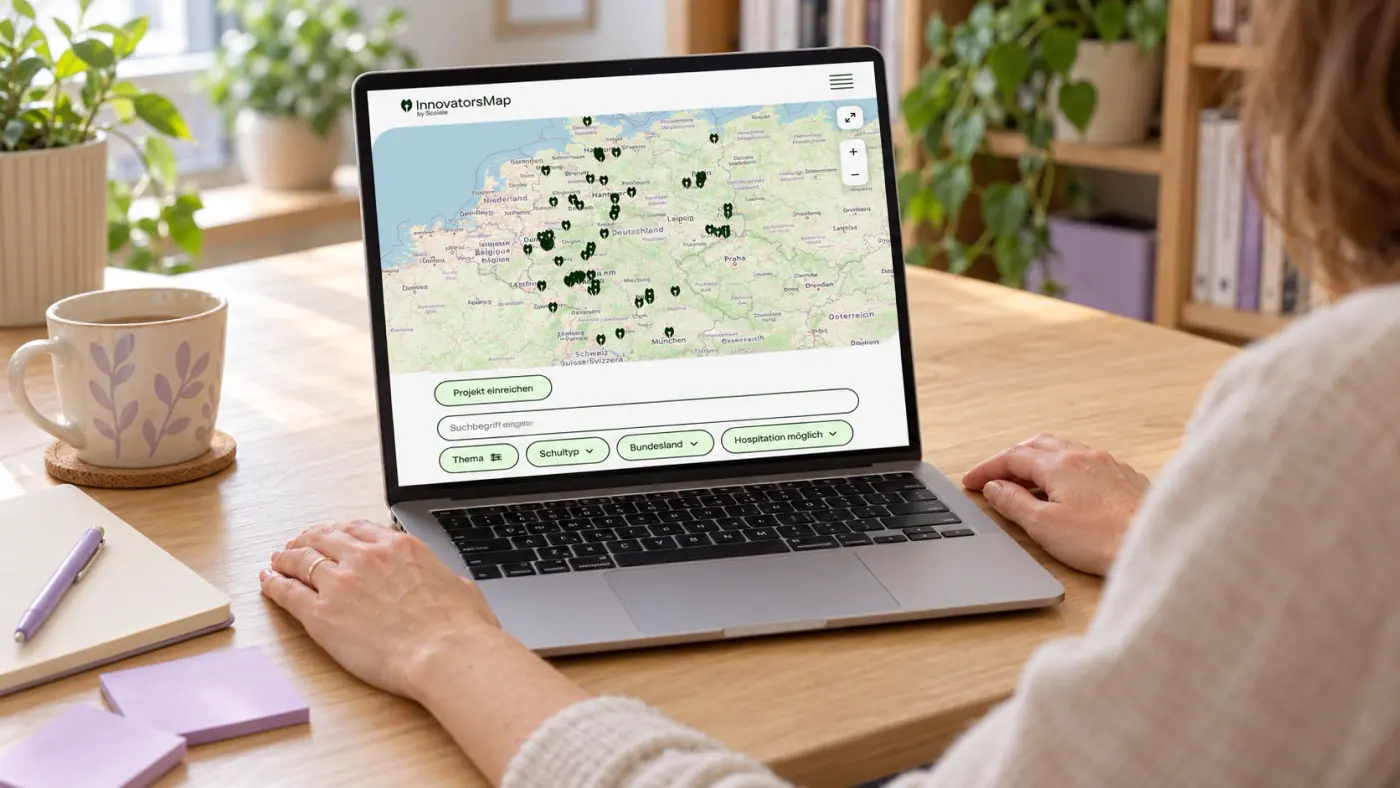
Learning together: School development and projects with Scolaia
A closer look at Scolaia’s InnovatorsMap, school visits, and AI prompt generator.
Sina Schriewer2 min read

Violence Prevention in Schools: Acting Early
Violence prevention starts long before an incident occurs. Schools need clear responsibilities, reliable communication channels, and jointly owned protection concepts.
Sina Schriewer7 min read