
Rethinking school: The wingbeat of Butterfly Pedagogy
Stefan Ruppaner and the Alemannenschule Wutöschingen show how self-directed learning can work. Butterfly Pedagogy breaks open the rigid 7G model and makes children active participants in learning.
Sina Schriewer4 min read
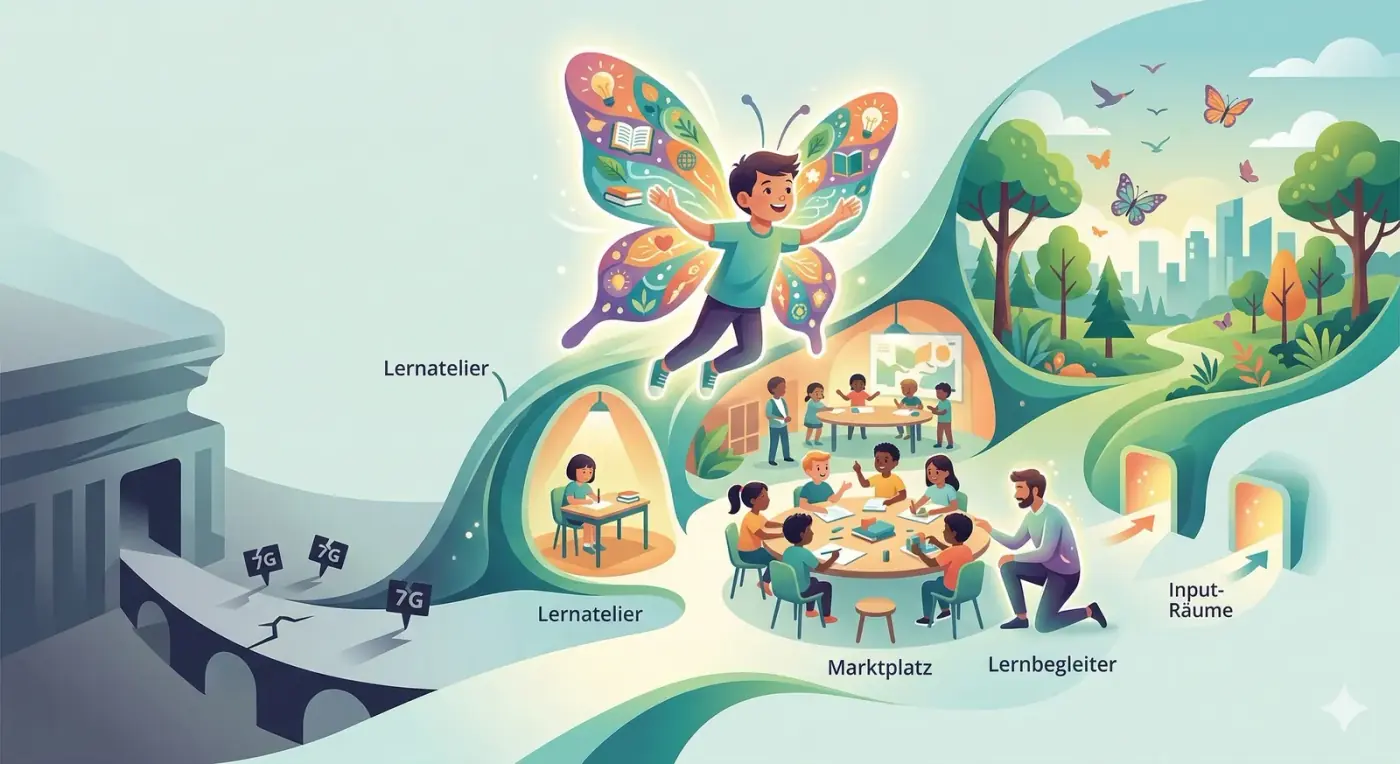
Stefan Ruppaner, longtime principal of the Alemannenschule Wutöschingen (ASW), likes to put it bluntly: “Instruction is the beginning of all evil.” What first sounds like educational anarchy turns out, on closer inspection, to be a carefully designed and successful school model in Germany: Butterfly Pedagogy. His presentation in Osnabrück on February 24, 2026, made clear that the idea is not to abolish education, but to free it from a rigid and outdated framework.
In Germany, school types, examinations, and many organizational rules are set by the federal states, which frames how models such as this one can operate.
From the 7G model to the butterfly
The traditional school system often presses children into what Ruppaner calls the “7G model”: the same-age students learn at the same time, with the same teacher, in the same room, at the same pace, learning the same material toward the same goal. In this environment, students remain in the passive role of a caterpillar waiting to be fed knowledge.
Butterfly Pedagogy breaks open that framework. Children are taken seriously as active participants in their learning process. The teacher no longer stands at the front as the sole source of knowledge, but works alongside students as a learning guide.
The room as the third educator
One major misconception about self-directed learning is that every child sits silently and alone in front of a tablet. The opposite is true. ASW replaced the traditional classroom with an architecture that adapts to children's needs. The space acts as a “third educator”:
- The learning studio: Each child has a personal desk. This room is intended for deep concentration, with a strict whispering culture that protects uninterrupted individual work.
- The marketplace: Students who want to collaborate on projects, discuss ideas, or learn reciprocally from one another move to the marketplace. Large round tables, standing desks, and cushions make it a space for cooperative work and social interaction.
- Input rooms and 20-minute sessions: Direct instruction still exists, but in a redesigned form. In dedicated rooms, learning guides offer short, highly focused subject sessions lasting no more than 20 minutes. Participation is voluntary: students decide whether they currently need that explanatory building block for their topic.
- The world as a classroom: Learning does not end at the school door. A substantial share of exploration and experience takes place outdoors, in nature, or in the immediate community. The real world often provides the strongest context for making theoretical knowledge tangible.
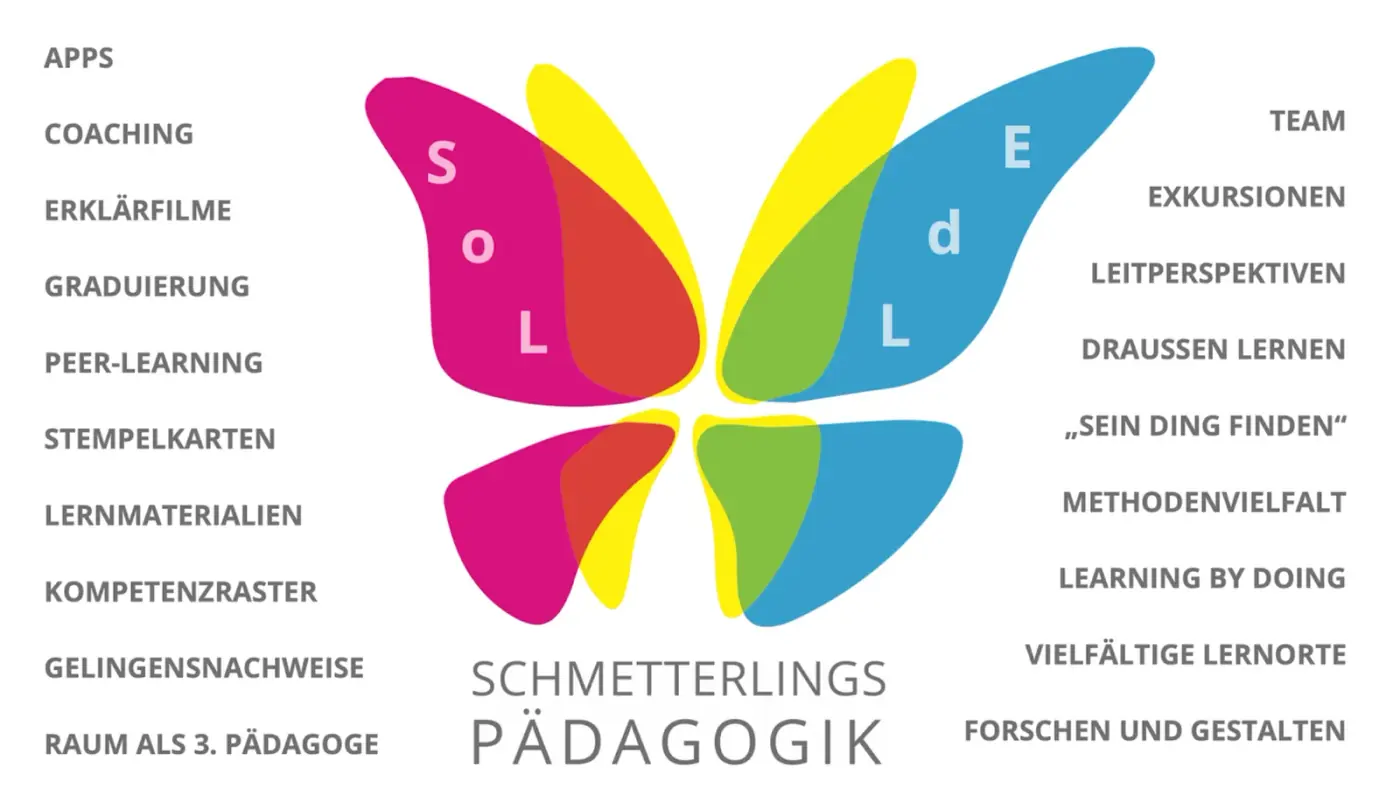
Equity through recognition as an educational aim
Social equity is a recurring issue in education. As speakers at the event also emphasized, German schools are often alarmingly effective at reproducing social divisions.
Butterfly Pedagogy emphasizes equity through recognition: every child should be seen and valued as a person, regardless of background or achievement. Individual learning support and success demonstrations are intended to put this aim into practice. This does not mean that social background no longer matters or that every child automatically receives the support they need.
Limits and conditions
In our interview on Butterfly Pedagogy in practice, Stefan Ruppaner makes clear that the approach does not work for every child. The choice of learning environment needs to reflect each child's needs. His positive experiences at the Alemannenschule therefore do not guarantee success for every child or school.
Putting the approach into practice also takes shared effort. In the interview, Ruppaner emphasizes teamwork and collaboration; making such a change as an individual teacher is difficult. Formal requirements remain, too: students at the Alemannenschule still take written final exams, including the Abitur, Germany's university entrance qualification.
Developing schools together
Butterfly Pedagogy offers ideas for rethinking learning spaces, relationships, and personal responsibility. School teams interested in the approach should consider which steps fit their school and how children can be supported along the way. The interview explores these questions through Ruppaner's experiences with parents, learning support, and teamwork.
Further links:
- Alemannenschule website: https://asw-wutoeschingen.de/
- Materials network: https://mnweg.org/
Related insights
Growing diversity in schools: Challenges and practical responses
Diversity in schools brings educational variety, but also places substantial demands on teachers. Recent School Barometer data and a study by Susanne Enssen point to systemic responses.
Sina Schriewer3 min read
Multidisciplinary Teams in Schools
Multidisciplinary teams in schools describe the systematic collaboration between teachers and other educational and social work professionals within the school.
Sina Schriewer10 min read

Butterfly Pedagogy: Stefan Ruppaner on School in 2035
Stefan Ruppaner explains how personal responsibility, success demonstrations, and consistent school development make educational transformation practically possible.
Sina Schriewer10 min read