
Butterfly Pedagogy: Stefan Ruppaner on School in 2035
Stefan Ruppaner explains how personal responsibility, success demonstrations, and consistent school development make educational transformation practically possible.
Sina Schriewer10 min read

Interview
Stefan Ruppaner on personal responsibility, success demonstrations, multi-professional teams, and his vision for school in 2035.
An interview by Sina Schriewer · 2026
In Germany, school law and examination frameworks are set by each federal state; the Jugendhilfe mentioned below refers to the local youth welfare system.
At Kipti, we often explore the question of what contemporary learning looks like in practice. One school that has been consistently rethinking this question for years is the Alemannenschule Wutöschingen. Its longtime principal Stefan Ruppaner shaped Butterfly Pedagogy there – a concept that takes students seriously as active shapers of their own learning process.
On February 24, 2026, Stefan captivated around 550 attendees in Osnabrück – and certainly many more watching via the livestream. In our first article, we gave an overview of the concept. This time, we go deeper.
I begin with a question I heard from various sides after the talk.
Sina: Honestly, does Butterfly Pedagogy – with its high degree of personal responsibility – actually work for all children?
Stefan: "No, of course Butterfly Pedagogy doesn't work for every child, but there are far more children who do much better with it than with the traditional school system. The number of children achieving excellent results while also being happy is far higher. Poor results still exist at the Alemannenschule Wutöschingen, of course, but the percentage of children who struggle with the approach is far lower than in traditional schools."
That immediately raises the question of who makes the decision in the first place. Before a child can participate in the concept, the adults – especially in families who are uncertain about it – have to come on board.
Sina: How do you win over parents and guardians, especially those who are initially skeptical and prefer the perceived security of the conventional system?
Stefan: "Parents are often won over because their children do so much better in our system than in the traditional one. But it is not our intention to convince parents at all. It is the parents' responsibility to decide which environment is best suited to their own child. If parents conclude that their child needs pressure and must learn to follow instructions, then the Alemannenschule is not the right school. We accept that, and we don't want to persuade anyone."
Sina: What role does collaboration with parents play in Butterfly Pedagogy, and how do you actively involve them in everyday school life?
Stefan: "It is the parents' responsibility to inform themselves about Butterfly Pedagogy. There is an old saying: 'Grass doesn't grow faster if you pull on it.' We expect parents to love their children and give them the freedom to take on responsibility. Many parents also train as learning helpers – though they then support other children at the school rather than their own. Parents support us especially in the area of learning through experience. There are many ways to participate and contribute."
One point from your talk stayed with me long afterward: the observation that schools are often disturbingly good at reproducing social hierarchies.
Sina: How do you create genuine equity in practice, so that the label "difficult clientele" finally loses its sting?
Stefan: "As long as we expect the same from all children and give everyone the same tests, there is no equity to be found. With us, children demonstrate their success. Success demonstrations are the heart of equity. Each child demonstrates the success they are capable of. For that reason, there is no such thing as a 'particularly difficult clientele.'"
That is exactly where it gets tricky for many schools – especially where students transfer to a conventional Gymnasium after grade 10 to sit the Abitur and are suddenly graded in the traditional way.
Sina: How does the transition from conventional grades to your success demonstrations work without sacrificing comparability?
Stefan: "In the Butterfly Pedagogy system, students can determine the number and level of difficulty of their success demonstrations. They decide for themselves what achievements to demonstrate. From these completed success demonstrations, we can generate a grade at any point, without ever having graded everyone at the same time. In final exams and in the Abitur, the situation is of course different. There, written exams are required. But even in these exams, students who grew up with Butterfly Pedagogy perform considerably better. The first Abitur taken by our school's students achieved an average of 1.7. The state average in Baden-Württemberg was 2.17."
For context, the Abitur is Germany's university entrance qualification, and lower numerical grades are better.
Impressive numbers. But school development and learning never succeed without setbacks.
Sina: What place does failure hold in your approach, and how does a productive culture of mistakes connect to the inner mindset the concept demands from staff and students?
Stefan: "Failure is part of life. Since we don't write class tests but instead produce success demonstrations, failure is not a problem. Success demonstrations can be repeated at any time. That removes the pressure. Making mistakes here is not a problem – it is an opportunity."
With so much individual learning, one question becomes particularly pressing for us at Kipti. Precisely where knowledge about individual students has to be held and shared within the team, we see the biggest gap in many schools.
Sina: How do you manage to share and keep current the information about individual children across the team – and does your concept of coaching conversations and learning support documentation actually mean more or less effort than in conventional school?
Stefan: "Even with a great deal of individual learning, it is easy to keep track because everything is organized centrally. The digital learning platform DiLer is at the core:
- Coaching conversations are documented there directly.
- Teachers, children, and parents all have access – everyone stays on the same page.
- Information is always current and transparent.
Teamwork becomes easier: fewer coordination meetings, because everyone accesses the same data.
The overall effort is significantly lower than in the traditional system:
- No duplicate documentation
- Less bureaucracy
- Above all: no instruction time that ties up staff
The time gained flows into what truly matters: coaching, relationships, and individual learning support."
What you describe only works if the whole team is behind it. Once multi-professional teams and external partners collaborate reliably, everyday school life changes noticeably.
Sina: What role do multi-professional teams play in making your pedagogy succeed, and how do you integrate external partners – for example, youth welfare services – concretely into everyday school life?
Stefan: "Multi-professional teams are a central success factor in our work at the Alemannenschule Wutöschingen. Our pedagogy depends on no one working alone – responsibility is consistently shared within the team.
Structurally, we are organized in so-called Quadrigen (teams of four): four learning companions form a fixed team and guide a learning group together. This produces continuous exchange, mutual support, and shared responsibility for children's development.
An important foundation for this collaboration is ViQ: all participants create a personal profile that is discussed within the team. This makes strengths, perspectives, and roles transparent, and they are deployed purposefully in the children's interest.
In addition, we work in subject teams that coordinate on inputs, materials, and learning packages. This creates quality and reliability in subject work while maintaining a high degree of individualization.
External partners – in particular Jugendhilfe (youth welfare services) – are fully integrated: at our school, this collaboration is coordinated by the educational team, which consists predominantly of social workers. They serve as the interface with the outside world and ensure that support systems are integrated seamlessly into everyday school life.
The result is a strong network that extends what school can be: not an isolated place of learning but a shared space for living and growing together."
A question that many teachers probably ask themselves after talks like yours.
Sina: What can I, as an individual teacher at a conventional school, do differently on Monday morning to bring a first piece of "butterfly" into my classroom?
Stefan: "That is not so easy, to be honest. The Churer Model could be a starting point. But Butterfly Pedagogy lives on the idea of teamwork and collaboration. On your own, it is difficult. Still, there should always be colleagues willing to join you."
To close, a look ahead. I am currently reading "Schule 2035" by Jöran Muuß-Merholz, so I simply had to ask.
Sina: What will the German school landscape look like in 2035?
Stefan: "If Butterfly Pedagogy has established itself by 2035, schools will be barely recognizable – while at the same time finally fulfilling their true purpose. Schools will no longer be places of instruction but open spaces for learning and living. The traditional classroom has disappeared, replaced by diverse learning landscapes in which children learn with self-determination, together, and with a sense of meaning. Time is no longer chopped into periods; it stands available as genuine space for development.
Instruction as we knew it no longer exists. In its place has come a culture of learning: shaped by trust, responsibility, and genuine relationships. Learners work largely in a self-organized way, supported by digital systems and artificial intelligence that enable individual learning at a completely new level. Knowledge is available at any time; what matters is no longer what you know but how you learn, think, collaborate, and create. At the same time, learning through experience holds a central place.
School is open to the world. Projects, real challenges, and collaborations with trades, science, culture, and society shape everyday life. Children experience themselves as capable and develop a sense of purpose in what they do.
The role of teachers has changed fundamentally: they are learning companions, coaches, and personalities who provide orientation and shape relationships. They work in teams, carried by a shared ethos.
Multi-professional networks have become a matter of course: social work, psychology, out-of-school partners, parents, and digital learning systems work together. School is no longer a closed space but a networked system.
And perhaps most importantly: the mindset has shifted. School is no longer oriented toward control and comparison but toward developing potential and finding joy in life. Children enjoy going to school because they are taken seriously there, allowed to grow, and given the chance to experience meaning. Germany has recognized that education is more than the transfer of knowledge. The four elements behind the HERZ framework – attitude, expertise, space and time – have become the foundation of the system.
In 2035, school is a place where young people are not being prepared for life – they are already in the middle of it.
And perhaps one could say: school has come back to what Aristotle already understood as its true purpose – not merely to accumulate knowledge, but to live a good, flourishing life and find one's leisure. Education then no longer serves adaptation but the unfolding of the human being in community, toward a life of responsibility, meaning, and happiness."
Stefan, thank you so much for your time and your candid answers. You give us a deep insight into a school practice that shows how differently school can already be conceived and lived today, compared with what most of us remember from our own school years. What stays with us most is the consistent shift in the question: not "How do we teach children the material?" but "How do we create spaces in which they can demonstrate their own success?"
We continue to follow the path of Butterfly Pedagogy with great interest and look forward to the next exchange.
About Stefan Ruppaner. Stefan Ruppaner was longtime principal of the Alemannenschule Wutöschingen (ASW) and is regarded as a pioneering thinker in Butterfly Pedagogy. Learn more about the school at asw-wutoeschingen.de.
Further reading. Our introductory article "Butterfly Pedagogy: Rethinking School" is published in the same thematic focus.
Related insights
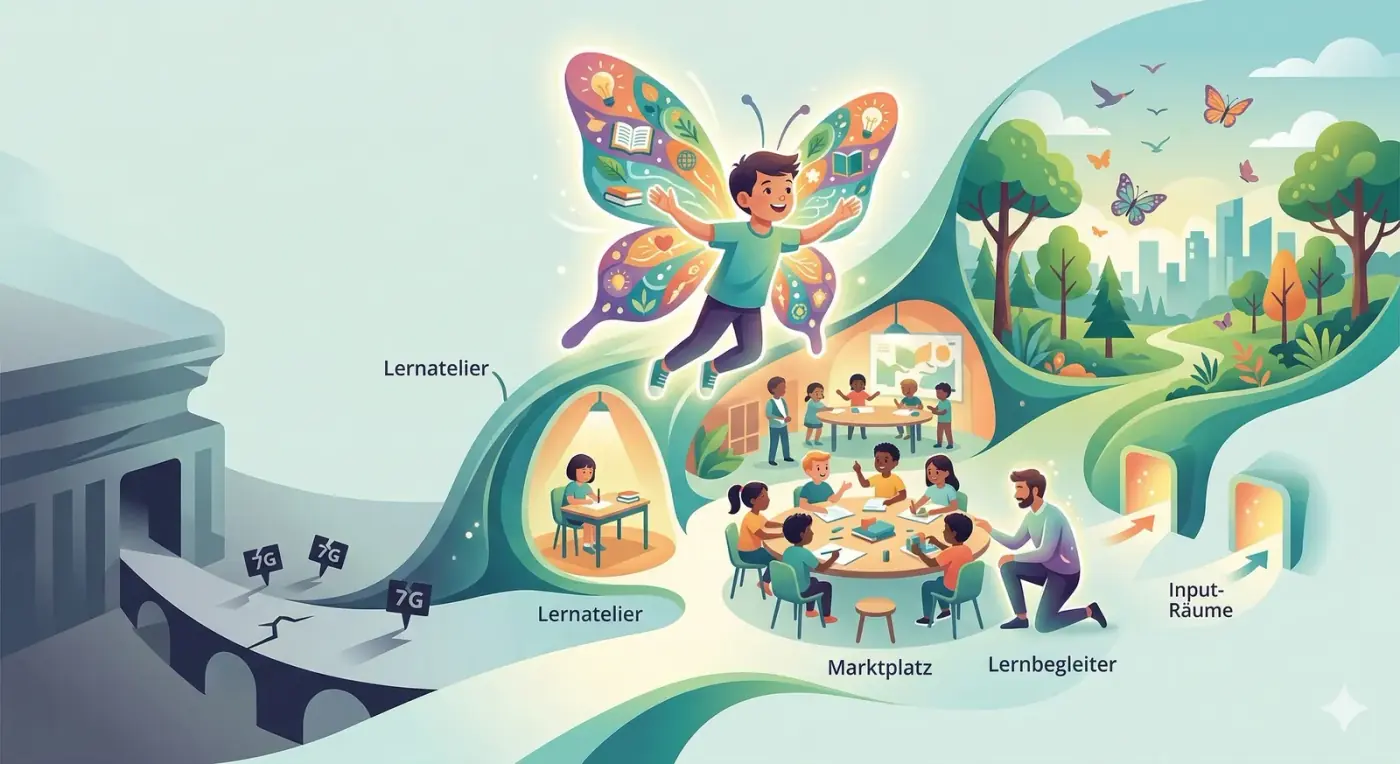
Rethinking school: The wingbeat of Butterfly Pedagogy
Stefan Ruppaner and the Alemannenschule Wutöschingen show how self-directed learning can work. Butterfly Pedagogy breaks open the rigid 7G model and makes children active participants in learning.
Sina Schriewer4 min read
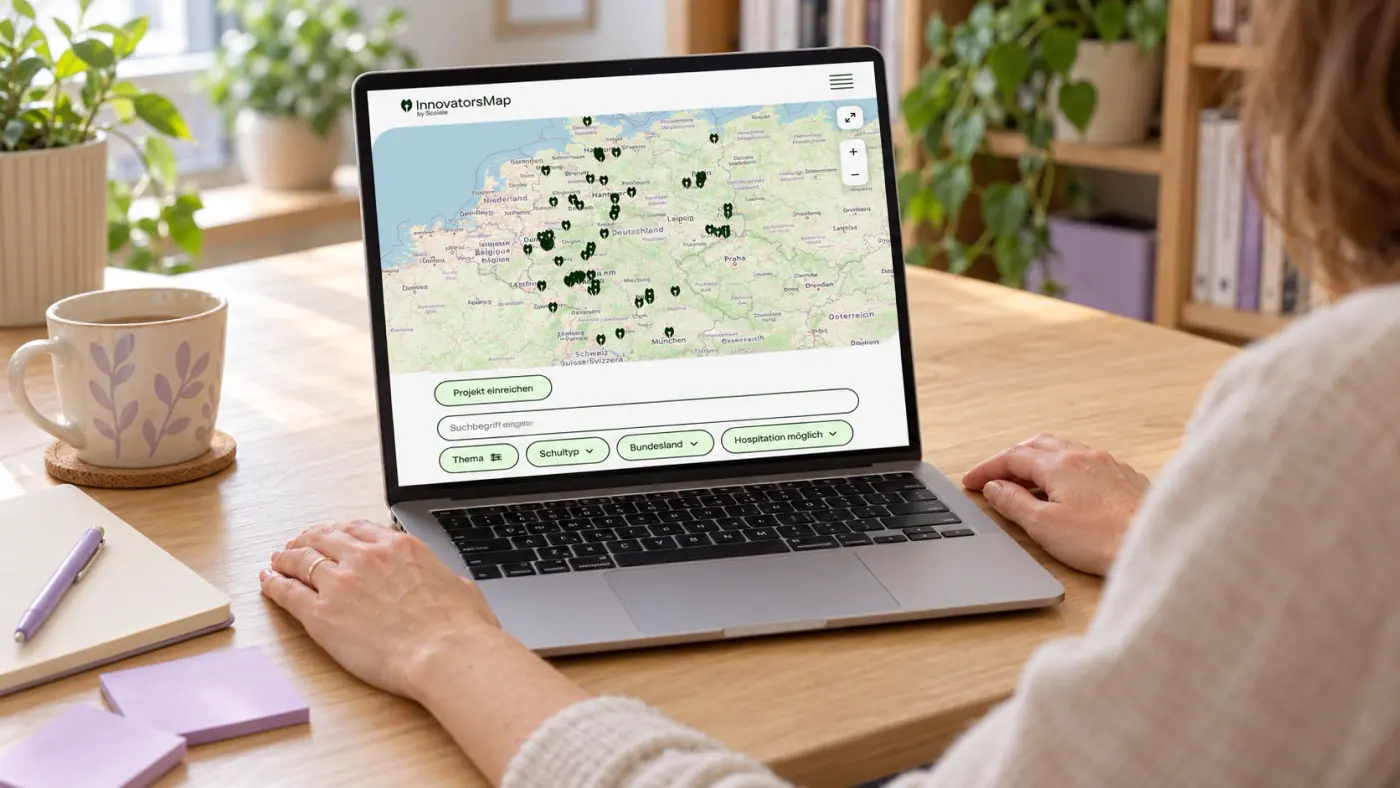
Learning together: School development and projects with Scolaia
A closer look at Scolaia’s InnovatorsMap, school visits, and AI prompt generator.
Sina Schriewer2 min read

Schools under pressure: Studies on workload and AI
Three studies explore the pressures schools face and how collaboration, clear processes, and AI may help reduce their workload.
Sina Schriewer6 min read