
Educational Opportunity Begins With Measurable Early-Childhood Quality
Current data shows that play and learning are not opposites. But to address educational disadvantages early, Kitas need clear standards and assessment integrated into everyday routines.
Sina Schriewer4 min read
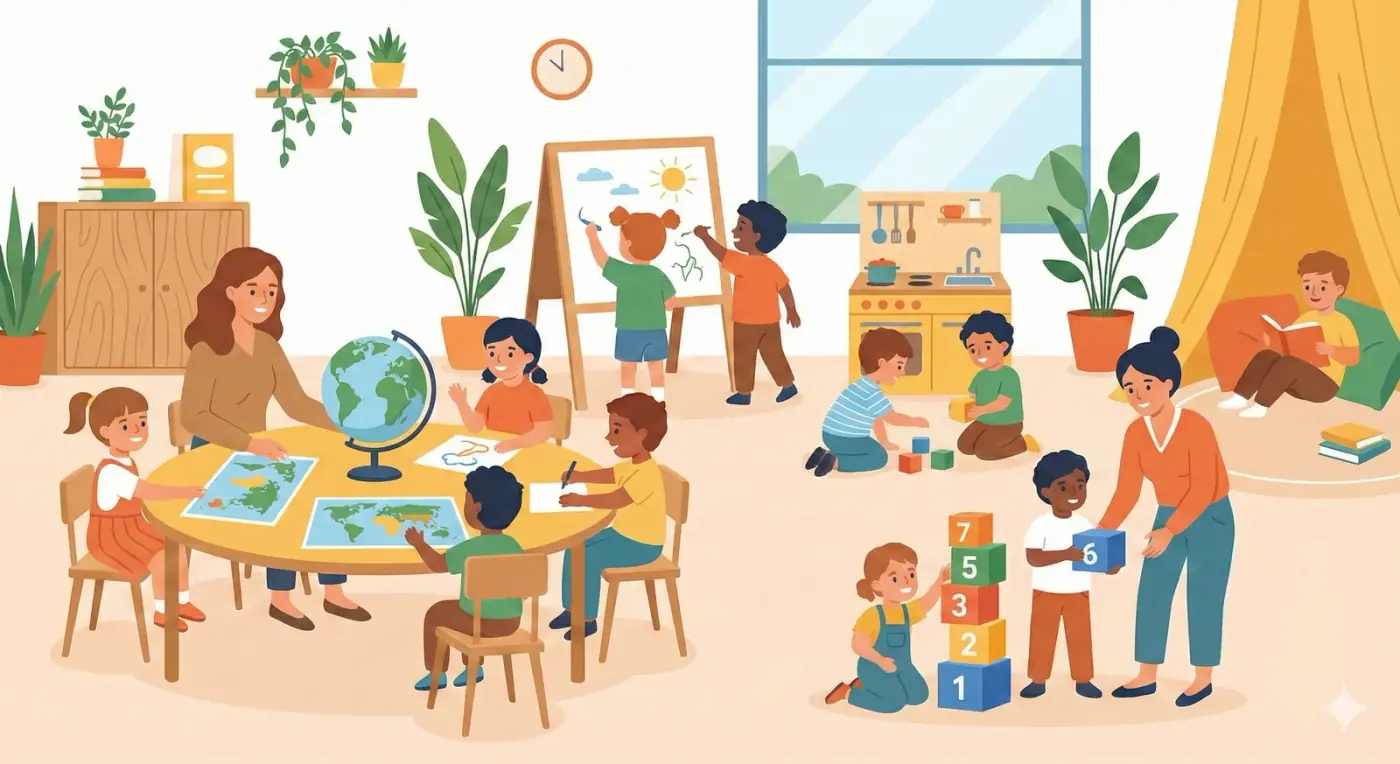
In Germany, "Kita" is the common umbrella term for early childhood care settings such as nurseries and kindergartens; the discussion below concerns the German system.
The debate around early childhood education in Germany often plays out in a field of tension: on one side stands the desire for an unburdened childhood and free play; on the other, the need to address educational disadvantages as early as possible. Current data and expert analyses show, however, that this does not have to be a contradiction. On the contrary: to do justice to every child, we need clear standards and the courage to look more closely.
The end of a myth: play versus learning
For a long time, the assumption persisted that "learning" at kindergarten age conflicts with children's need for play. New surveys (sometimes called "Baby-PISA") conclusively refute this. When five-year-old children are asked about their favorite activities, "learning new things" comes in just behind "playing" and "being creative."
Children do not draw a rigid line between play and education — for them, discovering the world, recognizing letters or quantities, is a natural and joyful process. The data also shows that children who develop a love of learning not only achieve better cognitive results, but also have stronger social-emotional competencies such as empathy and self-regulation.
Shedding light: why standards are necessary
A key finding from current discussions is the recognition that individual support is barely possible without standards. Without clear learning goals and reference values, developmental delays often remain invisible. "In the dark, all Kitas look the same" — yet a closer look reveals significant differences.
Particularly alarming is the "social gap": children from disadvantaged backgrounds can show developmental delays of up to 20 months by the age of five compared to their peers — in vocabulary or social behavior alike. To close these gaps, early childhood professionals need points of reference. Standards here do not serve to enforce uniformity but function as a diagnostic tool — to make inequality visible in the first place, and therefore addressable.
Assessment without test stress: the digital assistant
A frequent objection to greater "measurability" in Kitas is concern about overwhelming children with testing situations. The solution, however, lies not in traditional examinations but in "observation integrated into everyday routines."
Modern, in some cases digital, approaches allow practitioners to document developmental levels (such as motor skills, language, and social behavior) during the normal daily routine. Such systems — for example in the form of traffic-light indicators in apps — reduce the burden on early childhood educators and provide objective data to inform targeted pedagogical responses. The goal is not to measure children but to give practitioners confidence in their professional practice.
From childcare to educational investment
The long-term economic and social effects of early childhood education can scarcely be overstated. Young people who attended a high-quality Kita for at least one year achieve, at age 15, school results that correspond to an advantage of almost a full school year.
Nevertheless, the system often fails to reach the children who need it most. Alongside financial barriers, it is frequently "indirect barriers" — information deficits, administrative complexity, or cultural reservations — that prevent parents from placing their children in a Kita early on. The Kita of the future must therefore be more than a place of care: it must develop into a family center that actively involves parents and removes barriers.
Conclusion
Quality in early childhood education does not arise by chance — it requires structure, professional qualification, and deliberate interaction. When standards are used to identify individual potential, and when "learning" is understood as a child's natural joy, the Kita is the most effective place to achieve educational equity in Germany.
Bibliography and sources
This article is based on data, presentations, and discussion content from the February 2026 event Standards for Educational Quality vs. Individual Competency Development?
Sources used:
- OECD Berlin Centre & Stiftung Kinder forschen (2025): Solide Grundlagen schaffen (Laying Solid Foundations). Presentation slides by Andreas Schleicher. (Drawing on OECD studies including IELS and Education at a Glance.)
- OECD auf Deutsch (2026): Standards für Bildungsqualität vs. Individuelle Kompetenzförderung? (Standards for Educational Quality vs. Individual Competency Development?). Transcript of the video recording of the event on February 9, 2026. (https://www.youtube.com/watch?v=MaSrhTfEEt0)
- OECD Berlin Centre (2026): Veranstaltungsdetails und Hintergrundinformationen zum Webinar (Event Details and Background Information on the Webinar). Retrieved from the event website.
Related insights

Educational Opportunity in Germany Still Depends on Background
Social background still determines children's educational paths in Germany. A study by the Leibniz Institute for Educational Trajectories shows how educational inequality develops — and identifies three levers we need to move now.
Sina Schriewer4 min read

Aspiration and Reality in the German Education System
Public expectations of the German education system are high – but reality often falls short. An analysis of the Allensbach survey of 2024.
Sina Schriewer3 min read

Early Identification: Warning Signs and Digital Support
Assessment begins in the classroom. This overview looks at warning signs of dyslexia, dyscalculia, and ADHD—and how digital tools can support teachers with observation.
Björn Schriewer5 min read